
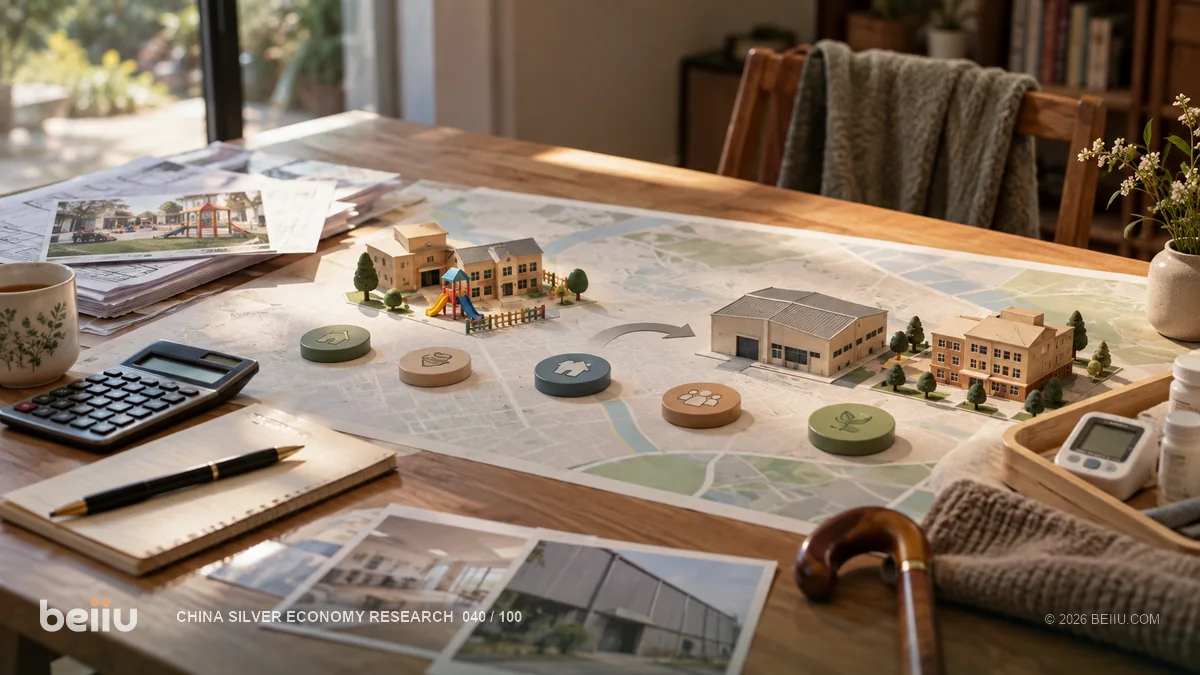
Challenges of Spatial Reconfiguration: Compliance Boundaries for Revitalizing Existing Assets and Integrating Elderly Care Scenarios
The article examines the feasibility of closing kindergartens and repurposing idle factories into elderly care facilities. It focuses on hard constraints such as property rights, fire safety, medical coordination, and operational capabilities, emphasizing that this cannot be viewed simply as a nationwide trend but requires rigorous case-by-case assessment
Conclusion: Against the backdrop of demographic shifts, how can closed kindergartens or idle industrial heritage sites be compliantly converted into elderly care facilities while avoiding structural risks related to property rights, fire safety, and medical coordination
Separate national facts, local variation and analytical inference
People entering retirement are not a homogeneous consumer segment. This study examines “Compliance Boundaries for Revitalizing Existing Assets and Integrating Elderly Care Scenarios” as a reviewable research object: The unit of analysis is a segment defined by health, income, education, digital ability, family responsibility and life tasks rather than age alone. In claims about “Compliance Boundaries for Revitalizing Existing Assets and Integrating Elderly Care Scenarios”, increased or declined requires a dated comparison and denominator, while mechanism, opportunity and brand judgment remain analytical rather than statistical.
The research question above requires this minimum evidence base: The minimum baseline identifies user, payer, influencer, current alternative, discretionary budget, digital-channel ability and reasons for continued use. If “Compliance Boundaries for Revitalizing Existing Assets and Integrating Elderly Care Scenarios” lacks an element, the study may state a direction or hypothesis, not a local service volume, procurement quantity or revenue estimate.
Read the fact cards, then verify definitions in the primary material
At the end of 2024, the population aged 60 and above reached 310.31 million, accounting for 22.0%; the large population base increases the potential demand for renovating existing spaces.
Definition source:China National Committee on Ageing: 2024 National Bulletin on the Development of Ageing Programmes
Open primary material ↗Researchers from the National Information Center estimate the current scale of the silver economy at approximately 7 trillion yuan, providing a macroeconomic market context for the revitalization of existing assets.
Definition source:National Development and Reform Commission: Expert Interpretation on Improving the Silver-Economy Policy System
Open primary material ↗Following the implementation of the delayed retirement policy, the family caregiving cycle will be extended, leading to a structural increase in demand for community-based elderly care facilities located nearby.
Definition source:NPC Standing Committee: Decision on Gradually Raising the Statutory Retirement Age
Open primary material ↗Primary sources and use boundaries
China National Committee on Ageing: 2024 National Bulletin on the Development of Ageing Programmes
The 2024 national ageing report records 310.31 million people aged 60 or over (22.0%) and 220.23 million aged 65 or over (15.6%) at year end.
Check source 01 ↗National Development and Reform Commission: Expert Interpretation on Improving the Silver-Economy Policy System
An expert interpretation published by the NDRC cites research estimates of roughly RMB 7 trillion and around RMB 30 trillion by 2035. These are estimates and forecasts, not national-account statistics.
Check source 02 ↗NPC Standing Committee: Decision on Gradually Raising the Statutory Retirement Age
The NPC Standing Committee decided to phase in higher statutory retirement ages over 15 years from 2025. Effects on consumption and care cycles are analytical implications requiring longitudinal evidence.
Check source 03 ↗National Bureau of Statistics: Statistical Communique of the People's Republic of China on the 2025 National Economic and Social Development
The National Bureau of Statistics reports a 2025 year-end population of 1.40489 billion; 323.38 million people aged 60 or over (23.0%) and 223.65 million aged 65 or over (15.9%). There were 7.92 million births and 11.31 million deaths, with natural growth of -2.41 per thousand.
Check source 04 ↗General Office of the State Council: Guiding Opinion on Developing the Silver Economy and Improving Older People's Well-being
The 2024 State Council opinion defines the silver economy as activities that provide products or services to older people and prepare for later life, and calls for scale, standards, clusters and brands.
Check source 05 ↗The fact cards below retain year, geography and source; the source cards return to definitions in the original material. Forecast, research estimate, catalogue listing, policy objective and observed outcome keep different evidence status even when they concern “Compliance Boundaries for Revitalizing Existing Assets and Integrating Elderly Care Scenarios”.
Move from correlation to a plausible operating mechanism
Although closing kindergartens or leaving factories idle provides physical space, converting them into elderly care facilities is far more than a simple functional swap. Strict review of administrative approvals for changes in planned land use, building fire safety acceptance standards, costs for accessibility modifications, and accessibility of medical emergency channels is essential. Furthermore, operational capabilities and effective demand within the surrounding population density (e.g., among the 310 million older adults) must be verified on the ground. Blindly advancing such projects may lead to asset idleness or operational losses; therefore, they should be treated as structural signals rather than universal trends, adhering to the prudent principle of 'one enterprise, one policy'.
The unit of analysis is a segment defined by health, income, education, digital ability, family responsibility and life tasks rather than age alone. In addition, Income, education, digital ability, health and family responsibility produce different consumption paths. “Explore the 'integration of medical and elderly care' model by embedding basic medical points or green channels within renovated spaces to enhance facility attractiveness” still requires temporal order, alternatives, local conditions and accountable implementation rather than a jump from macro correlation to sales or service effect.
Do not substitute an age band for actual ability to pay and life tasks. A concrete counterexample is: Researchers define segments, product and service teams validate tasks, and channels disclose acquisition bias instead of treating highly active recruits as all older people. Until that counterexample to “Compliance Boundaries for Revitalizing Existing Assets and Integrating Elderly Care Scenarios” is addressed, the conclusion retains conditions and a bounded scope.
Families, public services and industry change differently
For local governments, it is necessary to coordinate planning for the utilization of existing space to avoid duplicate construction and resource waste. For developers, it is essential to recognize the high compliance costs associated with fire safety and medical coordination and not underestimate the difficulty of renovation. For families, a lack of compliant age-friendly facilities in the vicinity will exacerbate caregiving anxiety. The industry should establish standardized spatial assessment models to ensure that renovated facilities truly serve the needs of an ageing society rather than becoming a new burden.
For “Compliance Boundaries for Revitalizing Existing Assets and Integrating Elderly Care Scenarios”, households care about time, cost, dignity and continued choice, public bodies must test identification, equity, fiscal durability and incident accountability, and operators must state the workforce, maintenance and compliance required by “Explore the 'integration of medical and elderly care' model by embedding basic medical points or green channels within renovated spaces to enhance facility attractiveness” and who pays for exceptions.
Researchers define segments, product and service teams validate tasks, and channels disclose acquisition bias instead of treating highly active recruits as all older people. Service radius, cost and access for “Compliance Boundaries for Revitalizing Existing Assets and Integrating Elderly Care Scenarios” therefore require separate calculations for dense cities, out-migration counties and dispersed rural communities.
Translate the macro judgment into one observable project
The minimum baseline identifies user, payer, influencer, current alternative, discretionary budget, digital-channel ability and reasons for continued use. Start with one place, one population and one task, preserving time, cost, failure and family backfill under the current alternative before introducing “Explore the 'integration of medical and elderly care' model by embedding basic medical points or green channels within renovated spaces to enhance facility attractiveness”.
The observation period for “Compliance Boundaries for Revitalizing Existing Assets and Integrating Elderly Care Scenarios” includes routine work, holidays, workforce change, unavailable devices or networks, refusal and exit, and requires the project to show whether the population is identified correctly, incidents close, and people, data and essential service recover when the intervention stops.
An opportunity becomes a project only through constraints
- 01Explore the 'integration of medical and elderly care' model by embedding basic medical points or green channels within renovated spaces to enhance facility attractiveness
Before turning “Explore the 'integration of medical and elderly care' model by embedding basic medical points or green channels within renovated spaces to enhance facility attractiveness” into a project, define place, population and the current alternative, then establish a comparable baseline for “autonomous choice”. For “Compliance Boundaries for Revitalizing Existing Assets and Integrating Elderly Care Scenarios”, need does not prove that households, institutions or public budgets can pay sustainably.
- 02Leverage the industrial aesthetic characteristics of idle factories to create community elderly care hubs with cultural distinctiveness, attracting highly educated older adults
Validation of “Leverage the industrial aesthetic characteristics of idle factories to create community elderly care hubs with cultural distinctiveness, attracting highly educated older adults” names the user, payer, operator and maintainer separately. If “Compliance Boundaries for Revitalizing Existing Assets and Integrating Elderly Care Scenarios” relies on permanent extra responsibility from pilot staff, the observed effect is unlikely to survive scale.
- 03Establish shared operational mechanisms by introducing professional elderly care institutions to manage existing spaces, thereby reducing owners' operational risks and management burdens
Test this direction against the counterexample “If the surrounding area lacks sufficient older adult support (which must be verified using census data), blind renovation will lead to severe supply-demand mismatches”. “Compliance Boundaries for Revitalizing Existing Assets and Integrating Elderly Care Scenarios” should move forward only if “digital ability” still improves after compliance, workforce, maintenance and exit costs are included.
Treat “Explore the 'integration of medical and elderly care' model by embedding basic medical points or green channels within renovated spaces to enhance facility attractiveness” as a proposition. Move forward only when autonomous choice improves against baseline and maintenance, workforce, compliance, payment and exit costs are not transferred to older people or frontline staff.
Put conditions that could overturn the conclusion in the main text
- 01Strictly prohibit unauthorized changes to building usage before passing fire safety acceptance and planning change approvals, as this exposes entities to legal risks
Turn “Strictly prohibit unauthorized changes to building usage before passing fire safety acceptance and planning change approvals, as this exposes entities to legal risks” into an entry and stop condition for “Compliance Boundaries for Revitalizing Existing Assets and Integrating Elderly Care Scenarios”, naming who checks it, which record governs and when review occurs. If “Explore the 'integration of medical and elderly care' model by embedding basic medical points or green channels within renovated spaces to enhance facility attractiveness” remains constrained, future optimisation is not a substitute for pause.
- 02Industrial heritage sites or older kindergartens often suffer from aging infrastructure, meaning renovation costs may far exceed expectations
This condition changes the scope of “Leverage the industrial aesthetic characteristics of idle factories to create community elderly care hubs with cultural distinctiveness, attracting highly educated older adults”. Stage review of “Compliance Boundaries for Revitalizing Existing Assets and Integrating Elderly Care Scenarios” retains non-completion, exit, complaint and excluded-population cases rather than counting only successful entrants.
- 03If the surrounding area lacks sufficient older adult support (which must be verified using census data), blind renovation will lead to severe supply-demand mismatches
For “If the surrounding area lacks sufficient older adult support (which must be verified using census data), blind renovation will lead to severe supply-demand mismatches”, compare rules, resources and cost across city, county and rural settings. National material indicates direction; the local decision on “Compliance Boundaries for Revitalizing Existing Assets and Integrating Elderly Care Scenarios” still needs field data, accountable owners and an executable alternative.
Put “Strictly prohibit unauthorized changes to building usage before passing fire safety acceptance and planning change approvals, as this exposes entities to legal risks” into entry and stop criteria. If local data, interviews, complaints or incomplete cases support this counterexample to “Compliance Boundaries for Revitalizing Existing Assets and Integrating Elderly Care Scenarios”, narrow, modify or stop rather than discard adverse evidence.
Measure average improvement and who is left out
- 01 · autonomous choice
For “Compliance Boundaries for Revitalizing Existing Assets and Integrating Elderly Care Scenarios”, “autonomous choice” retains population, geography, denominator, period and incomplete cases to test “Explore the 'integration of medical and elderly care' model by embedding basic medical points or green channels within renovated spaces to enhance facility attractiveness”, because an average improvement alone is insufficient.
- 02 · price sensitivity
For “Compliance Boundaries for Revitalizing Existing Assets and Integrating Elderly Care Scenarios”, report baseline, pilot and post-exit states for “price sensitivity”, including policy, workforce or system-version changes so external effort is not attributed to the intervention.
- 03 · digital ability
“Compliance Boundaries for Revitalizing Existing Assets and Integrating Elderly Care Scenarios” reads “digital ability” at aggregate and high-risk levels, and coverage does not prove equity when low-income, oldest-old, disabled or remote groups are omitted.
- 04 · aesthetic acceptance
“Compliance Boundaries for Revitalizing Existing Assets and Integrating Elderly Care Scenarios” assigns interpretive responsibility for “aesthetic acceptance”: who produces and reviews data, what triggers action and which record governs disagreement.
- 05 · continued use
For “Compliance Boundaries for Revitalizing Existing Assets and Integrating Elderly Care Scenarios”, “continued use” retains population, geography, denominator, period and incomplete cases to test “Leverage the industrial aesthetic characteristics of idle factories to create community elderly care hubs with cultural distinctiveness, attracting highly educated older adults”, because an average improvement alone is insufficient.
autonomous choice, price sensitivity, digital ability, aesthetic acceptance and continued use answer different questions about scale, process, outcome, equity or cost. Each metric for “Compliance Boundaries for Revitalizing Existing Assets and Integrating Elderly Care Scenarios” needs a population, denominator, period, version and missing-case record.
Build a durable point of view from evidence
BEIIU maintains that spatial reconfiguration must be built upon strict compliance and demand verification. We oppose any form of 'campaign-style' renovation and advocate for professional assessments to clearly define boundaries regarding property rights, fire safety, medical coordination, and operations. For BEIIU, the true opportunity lies in enabling existing spaces to become hubs connecting community resources with the needs of older adults through refined operations, rather than merely serving as physical containers.
BEIIU / 辈佑 considers public evidence, scenario constraints and real-world counterexamples together to identify which opportunities can move into product and partnership practice and which conditions require further observation. New primary evidence and field experience will continue to refine that perspective.
Turn macro research into five practical questions
Fact boundary
For “Compliance Boundaries for Revitalizing Existing Assets and Integrating Elderly Care Scenarios”, what can national evidence establish, what can it not establish, and which local data are required to answer the opening research question?
Current alternative
Before a new product or service addresses “Compliance Boundaries for Revitalizing Existing Assets and Integrating Elderly Care Scenarios”, how do families, communities or institutions complete the task, and what are its time, cost, failure and user-burden baselines?
Minimum test
Choose one bounded setting from “Explore the 'integration of medical and elderly care' model by embedding basic medical points or green channels within renovated spaces to enhance facility attractiveness”, change one material condition, and test “autonomous choice” together with at least one counter-metric.
Counterexample
For “Compliance Boundaries for Revitalizing Existing Assets and Integrating Elderly Care Scenarios”, actively look for “Strictly prohibit unauthorized changes to building usage before passing fire safety acceptance and planning change approvals, as this exposes entities to legal risks”; if it limits “Explore the 'integration of medical and elderly care' model by embedding basic medical points or green channels within renovated spaces to enhance facility attractiveness” locally, narrow the conclusion and decide whether to pause or use another path.
Public accountability
For “Compliance Boundaries for Revitalizing Existing Assets and Integrating Elderly Care Scenarios”, name who authorises entry, operates, handles exceptions, maintains data and equipment, and may stop the service; a missing role leaves the proposal as a hypothesis.
The continue, change or stop floor is: Do not scale when value depends only on an age label, subsidy or adult-child anxiety and the older person lacks a reason to continue. For “Compliance Boundaries for Revitalizing Existing Assets and Integrating Elderly Care Scenarios”, repeat this check at entry, mid-pilot and scale review, updating the conclusion, budget, ownership and exit arrangement.
References
For “Compliance Boundaries for Revitalizing Existing Assets and Integrating Elderly Care Scenarios”, this study prioritises original government, public-institution and international sources, retains reference years, and clearly labels forecasts or estimates.
- China National Committee on Ageing: 2024 National Bulletin on the Development of Ageing Programmes ↗
- National Development and Reform Commission: Expert Interpretation on Improving the Silver-Economy Policy System ↗
- NPC Standing Committee: Decision on Gradually Raising the Statutory Retirement Age ↗
- National Bureau of Statistics: Statistical Communique of the People's Republic of China on the 2025 National Economic and Social Development ↗
- General Office of the State Council: Guiding Opinion on Developing the Silver Economy and Improving Older People's Well-being ↗