
DEMOGRAPHY · POLICY · FAMILY · INDUSTRY · TECHNOLOGY
Understand China's ageing transition.
Then design the silver economy.
BEIIU connects official statistics, policy documents and industry practice across population change, public services, family care, consumption and age-tech.
Verify the facts, state the boundaries, then assess the opportunity.
Each study separates source evidence, structural analysis, industry opportunities and implementation risks. Forecasts are not presented as facts, and no single city or case is treated as the whole of China.
Population Structure and Generational Renewal
Understanding China's ageing through total population, births, deaths, age structure, regional disparities, and population cohorts, without exaggerating single-year changes as definitive conclusions.

Accelerating Ageing in 2025: The Structural Shear Between Birth and Death Rates
Based on official 2025 statistics, this analysis examines the deep structural drivers behind negative natural population growth and explores the long-term pressure on family intergenerational support systems resulting from the convergence of low fertility and high mortality.
Read article →
Idle Assets and Elderly Care Transition: Feasibility Boundaries from Kindergartens to Elderly Care Facilities
This discussion explores the structural conditions for converting idle kindergartens or factories into elderly care facilities, emphasizing key limiting factors such as planned land use, fire safety regulations, medical support, and operational capabilities.
Read article →
In-depth Perspective on Population Structure: Path Deduction from Total Peak to Deep Ageing
Based on official 2025 statistics, this analysis parses the structural characteristics of China's population transitioning from high-level total operation to a society of deep ageing, and explores the long-term impact of the shear between birth and death rates on family intergenerational support.
Read article →
Matching Elderly Care Resources Amid Regional Differentiation: A Supply-Demand Mismatch Analysis Based on Census Data
Utilizing age composition data from the Seventh National Population Census and combining it with the 2024 Bulletin on the Elderly Cause, this analysis examines the structural contradictions between the degree of ageing in different regions and the existing supply of elderly care resources.
Read article →
The Critical Point of Generational Burden: Structural Turning Points in Family Dependency Ratios Viewed Through 2025 Population Data
Based on 2025 statistical data, this analysis examines how the scissor difference between birth and death rates reshapes family dependency structures, exploring the long-term pressure on intra-family resource allocation and the inevitable evolution of intergenerational support models during the transition from a total peak to deep ageing.
Read article →
Resource Mismatch Under Regional Differentiation: Analysis of Urban-Rural Elderly Care Supply Differences Based on Census Data
Utilizing data from the Seventh National Population Census, this analysis dissects differences in age composition across regions, revealing structural contradictions between developed eastern regions and central-western regions regarding the degree of ageing and resource carrying capacity, and exploring feasible paths for changing planned land use and sinking resources.
Read article →
Reconstructing Family Care under Deep Ageing: From Peak Volume to Service Gaps
Based on 2025 population data and the 2020 census baseline, this analysis examines the pressure on family care following the proportion of the population aged 65 and over exceeding 15.9%. It explores the unsustainability of relying solely on children for support and evaluates the necessity of community-embedded services.
Read article →
Activating Existing Assets and Integrating Elderly Care Scenarios: Feasibility Boundaries and Risk Management
This discussion explores potential pathways for converting idle commercial or educational facilities into elderly care spaces, focusing on key constraints such as changes in planned land use, fire safety inspections, medical support facilities, and verification of operational requirements.
Read article →
Surging Dependency Ratios and the Restructuring of Family Care: A Structural Turning Point in Intergenerational Burden Revealed by 2025 Population Data
Based on data showing that the proportion of the population aged 60 and over reached 23.0% at the end of 2025, this analysis examines the historic shift in the dependency ratio. It explores the need to reallocate family care resources against a backdrop of persistently low birth rates and rising mortality.
Read article →
Rural Elderly Care and County-Level Service Acceptance Amidst Population Mobility
Analyzing the rural elderly population's reliance on county-level service networks under the trend of population concentration in urban areas, exploring how county medical centers can absorb overflow from family caregiving, and assessing the resilience of existing facilities in addressing deep ageing.
Read article →Low Birth Rate and Spatial Reconfiguration
Analyzing kindergarten contraction, changes in demand for schools and commercial facilities, and the transformation of idle factories and stock spaces. All transformations must discuss property rights, planning purpose, fire safety, barrier-free access, medical collaboration, transportation, and sustainable operations.

Reconfiguring Stock Spaces in Shrinking Communities: A Compliant Path from Kindergarten Closures to Community Elderly Care Hubs
Based on data showing a sharp decline in the number of kindergartens in 2023-2024, exploring the feasibility of transforming idle school buildings under property rights, fire safety, and barrier-free modifications, emphasizing the necessity of medical collaboration and operational validation.
Read article →
Symbiosis Between Industrial Heritage and Community Elderly Care: Property Rights and Operational Boundaries in Factory Repurposing
Analyze the transformation potential of vacant factories against the backdrop of population aging, with a focus on policy barriers to converting industrial land for elderly care, the lack of medical support, and sustainable operational models.
Read article →
Compliant Reconstruction of Existing Spaces: Property Rights and Functional Substitution Boundaries Following Kindergarten Closures
Based on data from 2023–2024 showing a sharp decline in the number of kindergartens, this analysis explores the structural barriers regarding property ownership, fire safety inspections, and changes in planned land use for vacant school buildings, rather than treating them as simple functional replacements.
Read article →
From Population Peak to Service Gap: A Symbiotic Path for Vacant Industrial Heritage and Community Elderly Care
Analyze how vacant factories can become potential carriers for regional elderly care service centers through medical integration and transportation optimization, given the demographic context of total population and aging rate in 2025.
Read article →
Spatial Substitution Under Kindergarten Contraction: Compliance Boundaries and Operational Validation for Transforming Existing Kindergartens into Elderly Care
Based on data from 2023–2024 showing a sharp decline in the number of kindergartens, this analysis explores the feasibility of converting idle early childhood education facilities into community elderly care nodes. The article strictly defines hard constraints regarding property rights changes, planning adjustments, fire safety inspections, and accessibility retrofitting, emphasizing that such transformations do not occur automatically but require conditional reconstruction following rigorous medical integration and demand assessments.
Read article →
Symbiosis Between Industrial Heritage and Community Elderly Care: Challenges in Property Rights, Fire Safety, and Sustainable Operations During Factory Repurposing
Analyze the potential and risks of idle factories as carriers for elderly care facilities. The article focuses on policy difficulties in converting industrial land to elderly care land, technical bottlenecks in high-standard fire safety renovations, and how to construct age-friendly environments in large spaces lacking natural light, emphasizing the necessity of resolving property rights clarification and medical integration issues.
Read article →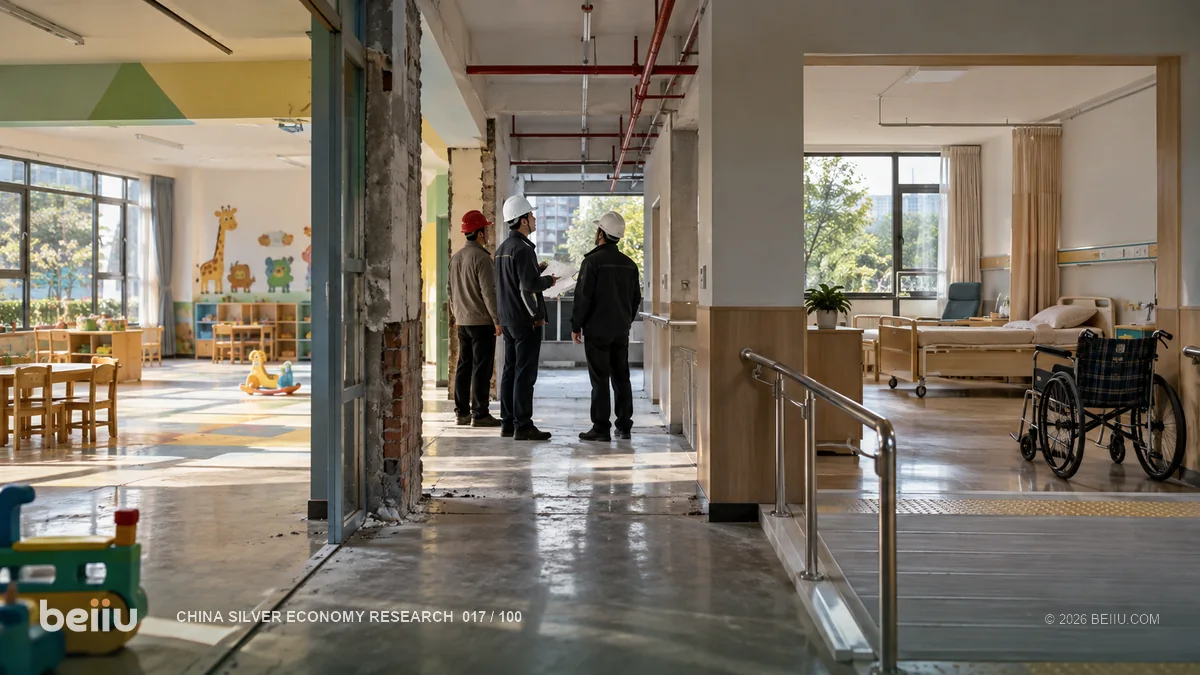
Compliant Repurposing of Excess Spaces Amidst Kindergarten Contraction: The Triple Boundaries of Property Rights, Fire Safety, and Medical Integration
Based on data from 2023-2024 showing a sharp decline in the number of kindergartens, this analysis explores the feasibility of converting vacant kindergarten facilities into elderly care infrastructure. It focuses on hard constraints such as property ownership, changes in planned land use, fire safety inspections, and accessibility modifications, emphasizing that closing a kindergarten does not automatically equate to an increase in elderly care resources.
Read article →
Structural Safety and Mixed-Function Compliance in Industrial Heritage Activation
The article explores that when transforming industrial heritage for elderly care, soil remediation, structural reinforcement, and fire safety compliance must be addressed first, rather than broadly discussing operational concepts. Combining the 2025 deep aging background and the 2029 policy window period, analyze how to safely reconstruct released education existing spaces into mixed-function communities serving the new elderly group, ensuring clear property rights and functional integration.
Read article →
Restructuring Commercial Facility Demand: The Logic of Transitioning from Retail Contraction to Community Elderly Care Hubs
Explores how commercial facilities affected by declining birth rates, such as small supermarkets and training institutions, can transition into elderly care hubs. Combining demographic data, this analysis examines the potential of such spaces to provide daily care and social functions, while highlighting planning restrictions and operational risks.
Read article →
Spatial Reconfiguration Under Regional Differentiation: Supply-Demand Mismatches and Compliance Paths Based on Census Data
Analyzes supply-demand mismatches in elderly care resources caused by population mobility in different regions. Combining 2025 demographic data, this analysis explores spatial reconfiguration strategies for shrinking cities and cities with accelerated aging, emphasizing regional differences in property rights, fire safety, and operational capabilities.
Read article →Elderly Care Policy and Public Service Network
Review the policy logic of basic elderly care services, the silver economy, elderly care service reform, capability assessment, urban-rural networks, and government procurement services.

From List to Human-Centric: Standardized Reconstruction of the Basic Elderly Care Service System
Based on the 'Opinions on Promoting the Construction of a Basic Elderly Care Service System' and the 'Opinions on Developing the Silver Economy to Enhance the Well-being of the Elderly,' this article explores how to translate policy lists into actionable service standards and analyzes the core role of capability assessment in accurately identifying needs.
Read article →
Service Networks Under Urban-Rural Dualism: From Planning Blueprints to Execution Gaps
Combining the '14th Five-Year National Plan for the Development of Elderly Care and the Construction of an Elderly Care Service System' with the 'Opinions on Deepening the Reform and Development of Elderly Care Services', this analysis examines the structural disparities in urban-rural elderly care service networks regarding infrastructure, talent allocation, and the integration of medical and elderly care services.
Read article →
The Efficiency Boundaries of Government-Purchased Services: From Scale Expansion to Quality Control
Based on the 'Opinions on Promoting the Construction of a Basic Elderly Care Service System' and opinions on the development of the silver economy, this analysis explores the challenges in quality monitoring when improving efficiency through government-purchased services and how to maintain service warmth during large-scale development.
Read article →
The Policy Logic of Medical-Elderly Care Integration: From Physical Proximity to Functional Fusion
Based on the '14th Five-Year National Plan for the Development of Elderly Care and the Construction of an Elderly Care Service System' and the 'Opinions on Deepening the Reform and Development of Elderly Care Services', this analysis parses the evolution path of medical-elderly care integration from simple 'having a hospital next door' to 'deep functional fusion'.
Read article →
Standardizing the Integration of Home Beds and Ability Assessments
Based on policies regarding basic elderly care services, home and community-based care, and long-term care insurance, this analysis examines how home care beds can effectively integrate with elderly ability assessments, while discussing the closed-loop relationship among service delivery, payment mechanisms, and quality supervision.
Read article →
Network Density and Precise Identification of Meal Assistance Services
To analyze coverage blind spots in the distribution of community meal assistance points between urban and rural areas, and to explore how to optimize the layout of meal assistance networks by precisely identifying the dining needs of elderly people living alone and of advanced age, thereby improving service accessibility and utilization rates.
Read article →
Institutional Tiering and Functional Positioning of Medical-Care Integration
To analyze the tiering strategies of elderly care institutions under conditions of limited medical resources, and to explore the functional positioning of different types of institutions in medical-care integration, avoiding homogenized competition and resource waste.
Read article →
Functional Layering of Integrated Medical and Elderly Care: From Physical Proximity to Process Reengineering
This analysis examines the requirements for 'integration of medical treatment, elderly care, and health maintenance' outlined in the '14th Five-Year National Plan for the Development of Elderly Care and the Construction of an Elderly Care Service System'. It explores how to transcend the limitations of mere physical proximity to achieve deep integration of medical resources and elderly care services in terms of function, information, and processes.
Read article →
Implementation of Lists and Human-Centric Assessment: Standardized Alignment of Basic Elderly Care Services
This article explores how to translate the 'List of Basic Elderly Care Services' in policy documents into executable standardized service processes. It focuses on analyzing the core role of comprehensive capacity assessment of the elderly in realizing the 'service seeking the person' model and examines the practical challenges in shifting from 'people seeking services' to 'services seeking people'.
Read article →
Resource Sinking under the Urban-Rural Dual Structure: Bridging the Gap Between Planning Blueprints and Execution Deficits
This article analyzes the challenges faced in the practical implementation of the urban-rural coordination goals proposed in the '14th Five-Year National Plan for the Development of Elderly Care and the Construction of an Elderly Care Service System'. It explores how to bridge the urban-rural resource gap through government procurement of service mechanisms and analyzes feasible paths for the basic construction of the network by 2029 as outlined in reform opinions.
Read article →Reconstruction of Consumption Among the New Generation of Older Adults
Research examines the differences among individuals born in the 1960s and later as they enter old age, focusing on education, digital literacy, aesthetics, health, travel, culture, family dynamics, and payment methods. It avoids treating the entire older adult population as a homogeneous market.

Structural Leap in the Silver Economy: From 7 Trillion to 30 Trillion
Based on estimates by the National Information Center regarding the scale of the silver economy, this analysis explores the driving logic behind market growth from 7 trillion to 30 trillion yuan between 2025 and 2035, and investigates the genuine shifts in consumer demand underlying this reconstruction.
Read article →
Bridging the Digital Divide: From Passive Acceptance to Active Reconstruction of Consumption Scenarios
Explores the intergenerational differences in digital literacy among those born after the 1960s, analyzing how digital technology has transformed from a barrier into a new tool for reconstructing their education, health, and social consumption.
Read article →
Compliant Reconstruction of Existing Space: From Kindergarten Closures to Community Care Hubs
Analyzes the feasibility of converting idle assets such as kindergartens into elderly care facilities against the backdrop of declining birth rates, with a focus on compliance boundaries regarding property rights, fire safety, and medical coordination.
Read article →
Preventive Consumption and the Lifelong Learning Cycle of the New Retiree Cohort
The article focuses on preventive consumption trends among the new retiree cohort aged 50 to 70, analyzing how delayed retirement policies reshape their work, income, and consumption cycles. Combining 2025 demographic data with the delayed retirement timeline, it explores how the supply side can shift from making decisions on behalf of children to supporting new older adults in active investment and lifelong learning planning.
Read article →
Reconstructing Consumption for a New Generation of Older Adults: A Paradigm Shift from Passive Support to Active Investment
Research explores the differences in education, digital literacy, and aesthetics among individuals born in the 1960s and later as they enter old age, examining how these generational characteristics reshape consumption structures and prevent the older adult population from being viewed as a homogeneous market.
Read article →
Digital Awakening and Scene Reconstruction: Transfer of Consumer Sovereignty among the Post-1960 Cohort
Explores how the post-1960 cohort transforms from passive service recipients to active reconstructors of consumption scenes through enhanced digital capabilities, analyzing their profound impact on family relationships, payment habits, and lifestyles.
Read article →
Shift in Consumer Sovereignty: Active Investment and Family Resource Restructuring by the Post-1960 Cohort
Focuses on the transformation in consumption behavior among individuals born in the 1960s as they enter old age, analyzing the trend from relying on children for support to actively investing in education and health. It explores the profound impact of this paradigm shift on family financial planning and intergenerational interaction models.
Read article →
Consumption Restructuring Under Regional Differentiation: Path Deduction from Total Peak to Deep Aging
Based on 2025 population data, analyzes the impact of regional differences in the distribution of older adults on consumption patterns, exploring how differences in education, digital literacy, and aesthetics among the new generation of older adults reshape regional consumption landscapes.
Read article →
Consumer Sovereignty and Co-Decision-Making Mechanisms of the New Elderly Group
The article analyzes the shift in consumer sovereignty among the new elderly group against the backdrop of deep aging, exploring how the supply side can shift from making decisions for children to co-decision-making. Combining 2025 population data and the delayed retirement policy, it assesses the impact of new consumption trends that respect aesthetics and brands on service restructuring in the context of the scale leap of the silver economy.
Read article →
Challenges of Spatial Reconfiguration: Compliance Boundaries for Revitalizing Existing Assets and Integrating Elderly Care Scenarios
The article examines the feasibility of closing kindergartens and repurposing idle factories into elderly care facilities. It focuses on hard constraints such as property rights, fire safety, medical coordination, and operational capabilities, emphasizing that this cannot be viewed simply as a nationwide trend but requires rigorous case-by-case assessment.
Read article →Home, Community, and Institutional Elderly Care
Analyze the framework of home-based care as the foundation, community-based care as the support, and institutional care as professional backing, focusing on home beds, meal assistance, door-to-door services, care for the disabled, integration of medical and elderly care, and institutional stratification.

Policy Implementation and Capability Assessment Alignment for Home Beds
Analyze the intersection between home bed construction requirements in the 'Opinions on Deepening the Reform and Development of Elderly Care Services' and the comprehensive assessment system for older adults' capabilities, exploring how to shift from 'people seeking services' to 'services seeking people'.
Read article →
Optimizing Meal Assistance Network Efficiency: Precise Identification of Vulnerable Groups and Dynamic Delivery Mechanisms
Explore how meal assistance services can break through the limitations of fixed outlets under the framework of the basic elderly care service list, utilizing precise identification technology to cover more vulnerable older adult groups, and establishing a dynamic response mechanism complementing mobile delivery with fixed outlets.
Read article →
Door-to-Door Services and the Payment Closed Loop for Long-Term Care Insurance
Analyze the implications of long-term care insurance pilot experiences for the payment system of home-based door-to-door services and explore how to build a sustainable business model for such services.
Read article →
Institutional Function Tiering Strategy: Disability Care and Rehabilitation Diversion under Medical-Elderly Care Integration
Analyze how elderly care institutions can achieve functional tiering by deeply integrating into the medical system within the framework where institutions serve as the professional pillar, diverting elderly individuals to different levels of facilities such as rehabilitation, stability, or palliative care based on assessment results to avoid homogenized competition.
Read article →
Home Bed Standardization Pathway: Service Instruction Mapping Driven by Assessment Data
Explore how home beds can effectively connect with the basic elderly care service list through standardized assessment data within the framework of the 'Opinions on Deepening the Reform and Development of Elderly Care Services', solving the implementation difficulties of shifting from 'people seeking services' to 'services finding people' in home-based elderly care.
Read article →
Operational Efficiency of Community Canteens: Balancing Universal Coverage with Precision Delivery
Explores how community canteens can optimize their operational models under the framework of the basic elderly care service list, combining mechanisms for precise identification of vulnerable seniors to build an efficient delivery network from community to home, thereby avoiding resource idleness.
Read article →
Scheduling, Skill Tiering, and Anti-Fraud Practices in Door-to-Door Care
The article focuses on specific execution details of door-to-door care, exploring how to optimize scheduling mechanisms, implement skill tiered management, ensure service traceability, and build anti-fraud defenses.
Read article →
Functional Tiering and Professionalization of Care for the Disabled in Medical-Elderly Care Integration
Explores how elderly care institutions can clarify their functional positioning based on disability levels, constructing a differentiated service system from daily living care to professional medical nursing, avoiding homogenized competition.
Read article →
Assessment-Driven Home Beds and Service Sustainability
Explores the necessity of establishing the promotion of home beds upon rigorous comprehensive assessments of older adults' capabilities to ensure effective linkage between home-based elderly care and professional medical resources.
Read article →
Precise Identification and Efficiency Optimization of Community Meal Assistance Networks
Analyzes how community meal assistance points can construct a high-density, low-cost community elderly care support network by precisely identifying lists of older adults in difficult circumstances and integrating multi-party resources.
Read article →Healthy Ageing and Long-Term Care
Discuss chronic diseases, rehabilitation, cognitive changes, medication, falls, long-term care insurance, and family care burdens, strictly distinguishing between consumer technology, health management, and medical diagnosis.

Payment Closed Loop for Home Care Under the Expansion of Long-Term Care Insurance Pilots
Analyzes the current operation status of the long-term care insurance system in 49 pilot cities and explores the feasibility of payment for home care services, the standardization of service catalogs, and the linkage with assessments of family care capabilities.
Read article →
The Family Frontline for Chronic Disease Management and Medication Safety
Explores how families can effectively manage chronic diseases and ensure medication safety amidst accelerating ageing, while distinguishing between consumer-grade health monitoring devices and medical diagnostic tools.
Read article →
Scenario-Based Application of Fall Prevention and Rehabilitation Technology
Analyzes the current status of fall prevention technology applications in homes and communities, exploring how rehabilitation technology can enhance the quality of life for older adults without infringing on privacy.
Read article →
Family Care Burdens and Policy Synergy in the Silver Economy
Explores pathways to alleviate family care burdens in the context of deep ageing, as well as how silver economy policies support the construction of family care systems.
Read article →
Closed-Loop Home Payment for Long-Term Care Insurance and Integration with Consumer Technology
Analyzes the payment mechanisms for long-term care insurance in home settings and explores how to incorporate validated consumer technologies into payment catalogs to address the economic sustainability of family caregiving.
Read article →
Boundaries of Consumer Technology in Family Chronic Disease Management and Adherence Improvement
Analyzes the role of consumer technology in chronic disease management in home settings, clarifies its boundaries with medical diagnosis, and explores how to improve medication adherence and avoid safety risks through technological means.
Read article →
Integration of Fall Prevention Technology and Humanistic Care in Home Settings
Studies the implementation of fall prevention technology in home settings and explores how rehabilitation technology can coordinate with long-term care policies to prevent accidents while also addressing the psychological needs of older adults.
Read article →
Mechanisms for Alleviating Family Care Burdens under Silver Economy Policy Guidance
Explores how silver economy policies can alleviate family care pressures through product and service innovation, promote intergenerational harmony, and ensure that commercial logic does not supersede basic livelihood needs.
Read article →
Classification and Compliance Pathways for Home-Based Care Services within the Long-Term Care Insurance Payment System
Analyzes how institutional frameworks in pilot cities for long-term care insurance support home-based chronic disease management and fall prevention, exploring payment pathway differences and compliance boundaries between medical diagnosis and consumer-grade health devices.
Read article →
Application of Rehabilitation Technology Scenarios in Chronic Disease Management under Silver Economy Standardization
Based on the 14th Five-Year Plan and opinions on the silver economy, analyzes technology applications in scenarios involving chronic diseases, rehabilitation, and cognitive changes, exploring the feasibility of family care burden relief and industrial synergy.
Read article →AI, Robotics, and Smart Ageing
Analysis of AI, millimetre-wave radar, robotics, platforms, and age-friendly smart home devices based on real-world tasks, reliability, privacy, algorithmic boundaries, service response, maintenance, and pilot evidence.

Inclusion in a Directory Does Not Equal Scenario Validation: Defining the Reliability Boundaries of Smart Ageing Products
This section examines the practical applicability of products promoted in the Ministry of Industry and Information Technology's (MIIT) 2024 promotion directory. It analyses why inclusion criteria cannot be directly equated with validation across all scenarios, emphasising the gap between policy lists and on-the-ground service delivery.
Read article →
From People Seeking Services to Services Seeking People: Reconstructing the Response Logic of the Basic Elderly Care System
This section analyses how the basic elderly care service list and elderly capability assessments support the 'services seeking people' model. It explores how platforms can precisely match demand and supply against the backdrop of accelerating population ageing.
Read article →
Algorithmic Boundaries and Privacy Red Lines: The Ethics of Deploying Millimetre-Wave Radar in the Home
This section examines the application of technologies such as millimetre-wave radar and fall detection in home scenarios, analysing the balance point between algorithmic boundaries, privacy protection, and family safety.
Read article →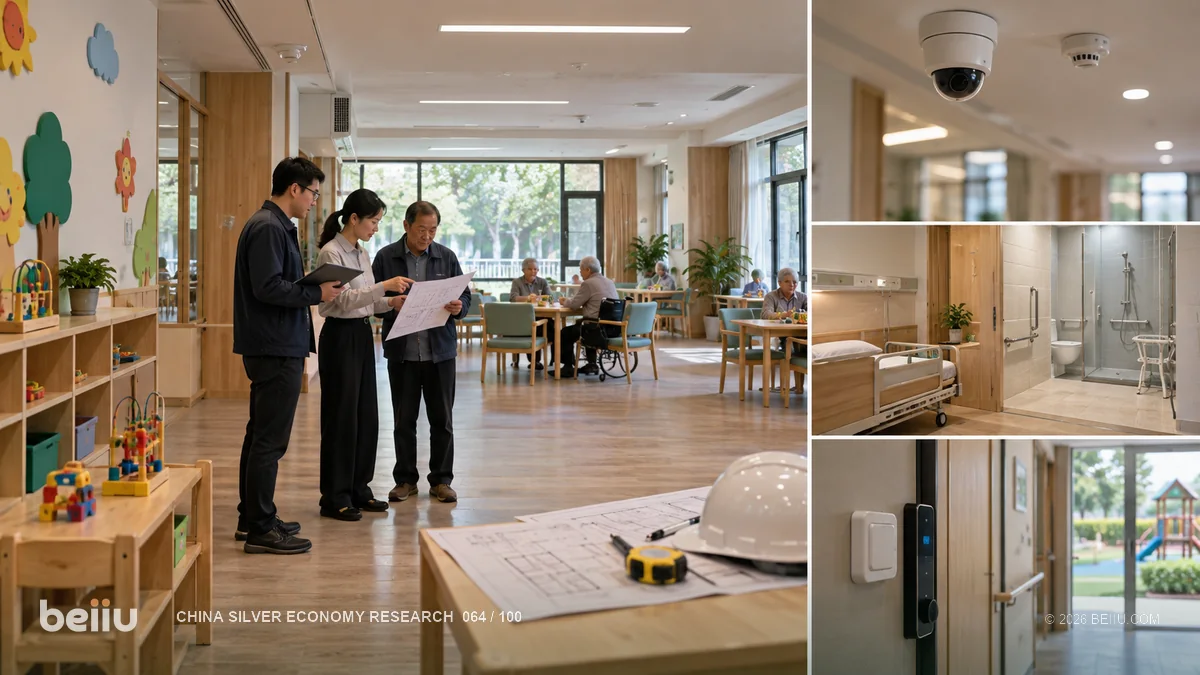
Activating Existing Spaces and Adapting for Aging Needs: A Compliance Path from Kindergartens to Community Hubs
Explores the feasibility of transforming closed kindergartens into aging care facilities, analyzing key constraints such as property rights, fire safety, medical coordination, and operational capabilities to avoid hasty transitions.
Read article →
Managing Sensor False Alarms and Manual Review Mechanisms Under Multi-Scenario Interference
The article deeply analyzes false positive and false negative issues of smart aging care products in complex scenarios involving multiple residents, pet activity, environmental occlusion, and network interruptions, proposing manual review solutions.
Read article →
Reconstructing Response Logic: A Technical Path from Passive Application to Active Discovery
Analyzes the technical path to achieve a substantive shift from 'people seeking services' to 'services finding people' under the basic elderly care service list system using data fusion and algorithmic early warning, while exploring privacy and algorithmic ethical bottom lines.
Read article →
Home Space Sovereignty: Privacy Ethics and Data Boundaries in Millimeter-Wave Radar Deployment
This discussion examines the ethical implications of millimeter-wave radar in home-based ageing care scenarios. It analyzes algorithmic decision boundaries, data privacy protection, and the importance of home space sovereignty, while proposing standards for 'Privacy by Design'.
Read article →
Reversible Design and Neighborhood Sharing Exit Mechanisms Following Kindergarten Closures
The article explores compliant pathways for space renovation after kindergarten closures, focusing on reversible design, handling of leftover children's facilities, neighborhood sharing models, and flexible exit mechanisms.
Read article →
Home Deployment of Millimeter-Wave Radar: Privacy Boundaries and Measured Risks of Algorithmic False Alarms
This evaluation assesses the deployment ethics of millimeter-wave radar in home environments, analyzing the impact of lighting changes and electromagnetic interference on fall detection accuracy, as well as the compliance boundaries for data privacy protection.
Read article →
Authorization Boundaries and Grassroots Responsibilities in Active Discovery Mechanisms
The article explores specific practices regarding data authorization following the principle of minimum necessity under a 'service-to-person' model, as well as the delineation of responsibilities for grassroots institutions and mechanisms to guarantee the right to withdraw in active service discovery.
Read article →Housing, Urban-Rural, and Regional Disparities
Analyze challenges related to elevator installation, age-friendly renovations, rural elderly care, county-level services, population mobility, and regional payment capacity in older residential communities. Avoid using solutions from first-tier cities as a proxy for the entire nation.

Regional Disparities in Payment Capacity for Elevator Installation and Age-Friendly Renovations in Older Residential Communities
Based on census data and the 14th Five-Year Plan, this analysis examines implementation challenges for elevator installation and age-friendly renovations in older residential communities across regions with varying payment capacities, and explores funding models for county-level and rural areas.
Read article →
Integrating Medical and Elderly Care and Addressing Talent Shortages in Building County-Level Service Networks
In light of the Opinions on Deepening the Reform of Elderly Care Services and the 14th Five-Year Plan, this analysis explores the bottlenecks in medical resources and professional talent that county-level regions face when constructing a coordinated service network comprising home-based care, community support, and institutional care.
Read article →
Pathways for the Transfer of Rural Elderly Care Needs to County Centers Driven by Population Mobility
Combining census data with silver economy policies, this analysis examines the impact of rural hollowing-out caused by population mobility on elderly care services, as well as the pathways for service upgrading and resource deployment at the county level as receiving hubs.
Read article →
Standardization Pathways for the Silver Economy Amidst Regional Payment Capacity Disparities
Drawing on the 14th Five-Year Plan and the Silver Economy Opinions, this analysis explores how standardization and cluster-based development can facilitate the nationwide implementation of the silver economy, despite uneven regional payment capacities.
Read article →
Funding Combinations and Definition of Construction and Maintenance Responsibilities for County-Level Renovations
The article analyzes funding combination strategies for installing elevators in older residential communities in low-income counties, as well as the allocation mechanisms for organizational management during construction and post-construction maintenance responsibilities.
Read article →
Talent Bottlenecks and Resource Deployment Strategies for County-Level Integrated Medical and Elderly Care Networks
Combining the 14th Five-Year Plan with population mobility trends, this analysis examines the challenges counties face in integrating medical and elderly care services while addressing the shortage of professional talent needed to serve rural ageing populations.
Read article →
County-Level Reception of Rural Elderly Care: Service Resilience and Mismatch Avoidance Under Population Mobility Trends
Based on population mobility data, this analysis examines how county-level service networks can flexibly respond to the transfer of rural elderly care needs, avoiding disconnection between hardware construction and actual demand.
Read article →
Constructing Tiered Standards for the Silver Economy Under Regional Payment Capacity Differentiation
Addressing disparities in regional payment capacity, this analysis examines how to balance standardization and personalization in the large-scale development of the silver economy, avoiding "one-size-fits-all" policies.
Read article →
Regional Discontinuities in the Cost-Sharing Mechanism for Renovating Older Residential Communities
Based on data from the Seventh National Population Census, this analysis examines the disparities in payment capacity across different regions regarding the installation of elevators and age-friendly modifications in older residential communities. It explores funding gaps and policy adaptation pathways in county-level and rural areas.
Read article →
County-Level Services Taking Over Rural Elderly Care Needs: Avoiding Resource Mismatch Amidst Population Inflow
Based on census data, this discussion explores the connection mechanisms between rural elderly care resources and county-level service networks under the trend of population returning to counties, focusing on resolving shortages in medical talent and insufficient facility coverage.
Read article →Industry, Finance, Talent, and Standards
Research on industrial clusters, state-owned and private enterprises, elderly care finance, talent training, standards, procurement, supply chains, brands, and sustainable business models.

Industrial Clustering and Standardization: The Underlying Logic of the Silver Economy's Scale Leap
Based on Document No. 1 of the General Office of the State Council [2024] and interpretations by NDRC experts, this analysis examines the clusterization, standardization, and branding pathways required for the silver economy to leap from 7 trillion to 30 trillion, exploring the necessity of state-owned and private enterprise collaboration and supply chain restructuring.
Read article →
Financial Lifeline and Long-Term Mechanisms: Closing the Funding Loop for High-Quality Development of the Pension Sector
Based on guidelines issued by the People's Bank of China and eight other departments, this analysis examines financing channels, financial safeguards, and service infrastructure under the phased targets for 2028 and 2035. It explores how to build long-term mechanisms that support the sustainable development of the silver economy.
Read article →
Talent Training and Supply Chain Resilience: Building Service Delivery Capabilities for the Silver Economy
Combining the definition of the silver economy with its current industrial status, this analysis explores how to address capability gaps and quality fluctuations in service delivery through upgrades to talent training systems and supply chain optimization within the context of scaled development.
Read article →
Branding and Sustainable Models: Commercial Breakthrough from Directory Selection to Scenario Validation
This analysis explores how enterprises can bridge the gap between 'directory selection' and 'scenario validation' amidst policy encouragement for branding, constructing sustainable business models and avoiding homogenized competition.
Read article →
Pilot Platforms and Key Component Collaboration within Industrial Clusters
The article explores the role of pilot platforms, shared testing mechanisms, and collaborative production of key components in supporting scale and standardization within the silver economy industrial clusters.
Read article →
Building a Financial Loop for the Silver Economy: Long-term Capital Returns and Risk Control
This analysis examines the phased goals in the guidelines from nine departments, exploring how financial tool innovation can match the attributes of pension assets while balancing the relationship between demand-side consumer loans and supply-side infrastructure loans.
Read article →
Composite Skills Model and Talent Retention: Deep Constraints on Silver Economy Service Delivery
This analysis examines the capability gaps in roles requiring composite talents in nursing, installation, and digital operations, exploring how vocational education systems can bridge state-owned enterprise standards and private enterprise innovation, and proposing solutions based on full-lifecycle training and retention mechanisms.
Read article →
Grading Procurement Evidence and Lifecycle Evaluation: Crossing the Threshold from Directory Access to Scenario Validation
Explores how to establish evidence grading and pilot thresholds in government and institutional procurement, emphasizing that branding must pass market validation and full lifecycle evaluation, avoiding the conflation of directory inclusion with scenario validation.
Read article →
Industrial Clusters and Standardization: The Critical Path Supporting the Trillion-RMB Scale Leap
Based on the scaling, clustering, and standardization paths defined in Document No. 1 of the General Office of the State Council (2024), combined with the National Development and Reform Commission's forecast of a 30 trillion RMB scale by 2035, this explores how industrial clusters can support the silver economy's leap from 7 trillion to 30 trillion RMB.
Read article →
Financial Vitality and Long-term Mechanisms: Solving the Funding Dilemma of Long-term Pension Investment
Based on the guidance opinions from the People's Bank of China and eight other departments, this analyzes how pension finance can support the coordinated development and long-term investment of state-owned and private enterprises in the silver economy through financing channel innovation, service foundations, and long-term mechanisms.
Read article →2035 Trends and BEIIU Insights
Within clearly defined boundaries for facts, forecasts, and scenario analysis, this section discusses population dynamics, service networks, consumption patterns, technology, and brand opportunities in 2035 to establish BEIIU's long-term research framework.

Structural Leap in the Silver Economy Scale and Restructuring of GDP Share by 2035
Based on estimates from the National Information Center, this analysis explores the structural logic behind the silver economy's transition from its current scale of 7 trillion yuan to 30 trillion yuan by 2035. It examines the drivers and policy support required to increase the sector's share of GDP from 6% to 10%.
Read article →
Reconstructing the Consumption Cycle Under Delayed Retirement
This analysis examines the impact of the gradual delay in the statutory retirement age on family life cycles, consumption patterns, and lifelong learning cycles, exploring the trend of integrating workplace and retirement life by 2035.
Read article →
Constructing County-Level Medical-Care Integration Networks and Addressing Shortages of Grassroots Talent
This discussion explores how counties can meet rural elderly care needs amid population mobility, build integrated medical-care service networks, and address the shortage of grassroots talent.
Read article →
Innovation in Financial Support Systems and Construction of a Closed-Loop Fund for the Elderly Care Sector
This analysis examines the financial support system under the guidance opinions issued by nine departments, exploring how innovations in financing channels and financial guarantee mechanisms can establish a closed-loop funding structure to facilitate the scale-up of the silver economy by 2035.
Read article →
Statistical Boundaries of Silver Economy Expansion and Feasibility of Industrial Implementation
Based on estimates from the National Information Center, this section explores the structural logic behind the silver economy's transition from 7 trillion to 30 trillion by 2035, analyzing the macro significance of its share of GDP rising to 10% and the industrial conditions supporting this growth.
Read article →
Reshaping of Family Consumption Cycles and Care Responsibilities by Delayed Retirement Policies
Combining the policy of gradual delayed retirement, this analysis examines the impact of extended working cycles on consumption, care, and lifelong learning, exploring family strategy adjustments under demographic changes projected for 2035.
Read article →
Challenges in Implementing Integrated Medical and Nursing Care in Counties and Strategies for Retaining Grassroots Talent
Focusing on the system's maturity phase in 2035, this analysis explores how counties can address the dispersion of medical resources and the loss of healthcare professionals to build a self-sustaining ecosystem independent of urban centers.
Read article →
From Catalog Entry to Scenario Validation: Building Reliability for Silver Economy Products
Analyzing the market expansion phase in 2035, this section examines how enterprises can move beyond reliance on policy dividends by establishing a brand moat through reliability testing in real family settings.
Read article →
The Window Period Before Service Network Stabilization: Strategic Alignment of the 2029 Milestone and 2035 Goals
Based on the targets of a substantially established network by 2029 and a mature, stabilized system by 2035 outlined in the 'Opinions on Deepening the Reform and Development of Elderly Care Services', this analysis examines the critical window for building service networks in light of the 2025 population base.
Read article →
Retirement Extension and the Reconstruction of the Consumption Cycle: Business Opportunities from Extended Work to Lifelong Learning
Combining the progressive retirement extension policy with forecasts on the scale of the silver economy, this analysis examines how an extended work cycle reshapes consumption patterns, lifelong learning, and family care structures.
Read article →