
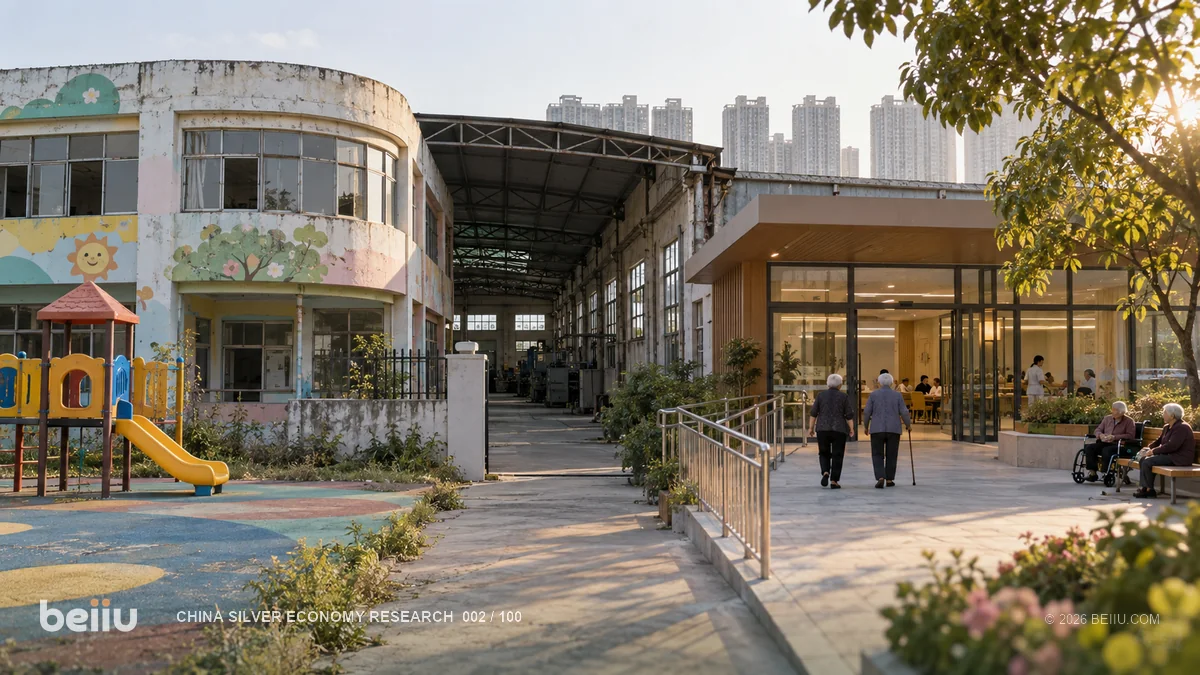
Idle Assets and Elderly Care Transition: Feasibility Boundaries from Kindergartens to Elderly Care Facilities
This discussion explores the structural conditions for converting idle kindergartens or factories into elderly care facilities, emphasizing key limiting factors such as planned land use, fire safety regulations, medical support, and operational capabilities
Conclusion: Can idle kindergartens or factories be directly converted into elderly care facilities, What hard constraints do they face during this transition
Separate national facts, local variation and analytical inference
Demographic structure is a long-run constraint, not a single market-size number. This study examines “compliance and operation of kindergarten conversion” as a reviewable research object: The unit of analysis combines annual population flows, year-end age stocks, net migration and household structure rather than one ageing percentage. In claims about “compliance and operation of kindergarten conversion”, increased or declined requires a dated comparison and denominator, while mechanism, opportunity and brand judgment remain analytical rather than statistical.
The research question above requires this minimum evidence base: The minimum baseline covers several years of births, deaths, net migration, populations aged 60+ and 65+, living arrangement, disability and service supply. If “compliance and operation of kindergarten conversion” lacks an element, the study may state a direction or hypothesis, not a local service volume, procurement quantity or revenue estimate.
Read the fact cards, then verify definitions in the primary material
As of the end of 2025, the national population aged 60 and above reached 323.38 million, and the large base makes the demand for diverse elderly care facilities increasingly urgent.
Definition source:National Bureau of Statistics: Statistical Communique of the People's Republic of China on the 2025 National Economic and Social Development
Open primary material ↗In 2024, the population aged 60 and above was 310.31 million, accounting for 22.0%.
Definition source:China National Committee on Ageing: 2024 National Bulletin on the Development of Ageing Programmes
Open primary material ↗The seventh national population census provided baseline data on age composition for various regions, which can be used to analyze differentiated demands for elderly care facilities across different areas.
Definition source:National Bureau of Statistics: Age Structure in the Seventh National Population Census
Open primary material ↗Primary sources and use boundaries
National Bureau of Statistics: Statistical Communique of the People's Republic of China on the 2025 National Economic and Social Development
The National Bureau of Statistics reports a 2025 year-end population of 1.40489 billion; 323.38 million people aged 60 or over (23.0%) and 223.65 million aged 65 or over (15.9%). There were 7.92 million births and 11.31 million deaths, with natural growth of -2.41 per thousand.
Check source 01 ↗China National Committee on Ageing: 2024 National Bulletin on the Development of Ageing Programmes
The 2024 national ageing report records 310.31 million people aged 60 or over (22.0%) and 220.23 million aged 65 or over (15.6%) at year end.
Check source 02 ↗National Bureau of Statistics: Age Structure in the Seventh National Population Census
The Seventh National Population Census provides national and regional age-structure baselines. It supports comparison at the census reference point, not a stand-alone forecast of local demand in 2026.
Check source 03 ↗CPC Central Committee and State Council: Opinion on Deepening Reform and Development of Elderly-Care Services
The eldercare reform opinion calls for a tiered, classified, broadly accessible, urban-rural and sustainable service system, with staged objectives for 2029 and 2035.
Check source 04 ↗The fact cards below retain year, geography and source; the source cards return to definitions in the original material. Forecast, research estimate, catalogue listing, policy objective and observed outcome keep different evidence status even when they concern “compliance and operation of kindergarten conversion”.
Move from correlation to a plausible operating mechanism
Converting idle kindergartens or factories into elderly care facilities is not a simple physical substitution of space but involves complex structural adjustments. First, changes in planned land use must comply with territorial spatial planning; converting kindergarten land use to elderly care land use requires strict approval. Second, fire safety regulations represent the greatest obstacle, as personnel density and evacuation requirements differ significantly between kindergartens and nursing homes, and the cost of fire safety renovations for old factories is high. Furthermore, medical coordination, barrier-free transportation, and the provision of professional caregivers are key to operational success. Without these conditions, so-called 'transitions' amount to conceptual hype and cannot form a sustainable business model. Therefore, such projects must be viewed as conditional reuse options rather than a universal trend.
A fall in kindergarten numbers establishes an aggregate education trend; it does not prove that one building is vacant or replace title, use, fire, structural and operating review. In addition, Population cohorts, regional mobility and household size jointly reshape demand. “Utilize the existing barrier-free foundations of educational facilities to low-cost renovate them into day care centers or dementia care units” still requires temporal order, alternatives, local conditions and accountable implementation rather than a jump from macro correlation to sales or service effect.
Do not project a national average directly onto a city, county or household. A concrete counterexample is: When the property still carries education duties, title is disputed or required care conditions cannot be obtained, the sound conclusion may be not to convert. Until that counterexample to “compliance and operation of kindergarten conversion” is addressed, the conclusion retains conditions and a bounded scope.
Families, public services and industry change differently
For local governments, revitalizing idle assets requires prudent assessment of renovation costs and operational risks to avoid blindly promoting projects that lead to resource waste. For operators, it is essential to verify local medical resource support and transportation accessibility; otherwise, projects will be difficult to sustain. For families, the implementation of such renovation projects implies a potential increase in community elderly care supply, but risks such as project abandonment or substandard service quality must be guarded against. At the industry level, this requires practitioners to possess cross-sectoral resource integration capabilities rather than relying solely on capital accumulation.
For “compliance and operation of kindergarten conversion”, households care about time, cost, dignity and continued choice, public bodies must test identification, equity, fiscal durability and incident accountability, and operators must state the workforce, maintenance and compliance required by “Utilize the existing barrier-free foundations of educational facilities to low-cost renovate them into day care centers or dementia care units” and who pays for exceptions.
Statistical agencies own definitions, civil-affairs and health authorities own service data, and local project teams must translate population into auditable task volumes. Service radius, cost and access for “compliance and operation of kindergarten conversion” therefore require separate calculations for dense cities, out-migration counties and dispersed rural communities.
Translate the macro judgment into one observable project
Review each property for title, planning use, egress, vertical circulation, sanitation and kitchen conditions, nearby older residents and catchment, with separate conversion and operating cash flows. Start with one place, one population and one task, preserving time, cost, failure and family backfill under the current alternative before introducing “Utilize the existing barrier-free foundations of educational facilities to low-cost renovate them into day care centers or dementia care units”.
The observation period for “compliance and operation of kindergarten conversion” includes routine work, holidays, workforce change, unavailable devices or networks, refusal and exit, and requires the project to show whether the population is identified correctly, incidents close, and people, data and essential service recover when the intervention stops.
An opportunity becomes a project only through constraints
- 01Utilize the existing barrier-free foundations of educational facilities to low-cost renovate them into day care centers or dementia care units
Test this direction against the counterexample “Strictly prohibit unauthorized changes to building use before fire safety acceptance and planning change issues are resolved”. “compliance and operation of kindergarten conversion” should move forward only if “age structure” still improves after compliance, workforce, maintenance and exit costs are included.
- 02Combine idle factory buildings in industrial parks to create regional elderly care complexes integrating rehabilitation training and long-term care
For “compliance and operation of kindergarten conversion”, “Combine idle factory buildings in industrial parks to create regional elderly care complexes integrating rehabilitation training and long-term care” starts with one place, one task and one defined population, records routine, exception, refusal and incomplete cases, and retains a workable path without the intervention.
- 03Explore the 'public construction, private operation' model to introduce professional institutions to operate renovated facilities, thereby reducing the government's fiscal burden
Before turning “Explore the 'public construction, private operation' model to introduce professional institutions to operate renovated facilities, thereby reducing the government's fiscal burden” into a project, define place, population and the current alternative, then establish a comparable baseline for “service access”. For “compliance and operation of kindergarten conversion”, need does not prove that households, institutions or public budgets can pay sustainably.
Treat “Utilize the existing barrier-free foundations of educational facilities to low-cost renovate them into day care centers or dementia care units” as a proposition. Move forward only when age structure improves against baseline and maintenance, workforce, compliance, payment and exit costs are not transferred to older people or frontline staff.
Put conditions that could overturn the conclusion in the main text
- 01Strictly prohibit unauthorized changes to building use before fire safety acceptance and planning change issues are resolved
For “Strictly prohibit unauthorized changes to building use before fire safety acceptance and planning change issues are resolved”, compare rules, resources and cost across city, county and rural settings. National material indicates direction; the local decision on “compliance and operation of kindergarten conversion” still needs field data, accountable owners and an executable alternative.
- 02Avoid neglecting technical requirements such as medical emergency access routes and hospital-acquired infection control
Once “Avoid neglecting technical requirements such as medical emergency access routes and hospital-acquired infection control” holds, pause the affected stage and establish facts before narrowing, modifying or exiting. Risk in “compliance and operation of kindergarten conversion” cannot be assigned to user capability or absorbed indefinitely by families and frontline staff.
- 03Beware of overestimating market demand while ignoring the verification of actual payment capacity and willingness to reside in surrounding communities
Turn “Beware of overestimating market demand while ignoring the verification of actual payment capacity and willingness to reside in surrounding communities” into an entry and stop condition for “compliance and operation of kindergarten conversion”, naming who checks it, which record governs and when review occurs. If “Explore the 'public construction, private operation' model to introduce professional institutions to operate renovated facilities, thereby reducing the government's fiscal burden” remains constrained, future optimisation is not a substitute for pause.
Put “Strictly prohibit unauthorized changes to building use before fire safety acceptance and planning change issues are resolved” into entry and stop criteria. If local data, interviews, complaints or incomplete cases support this counterexample to “compliance and operation of kindergarten conversion”, narrow, modify or stop rather than discard adverse evidence.
Measure average improvement and who is left out
- 01 · age structure
“compliance and operation of kindergarten conversion” reads “age structure” at aggregate and high-risk levels, and coverage does not prove equity when low-income, oldest-old, disabled or remote groups are omitted.
- 02 · household dependency
“compliance and operation of kindergarten conversion” assigns interpretive responsibility for “household dependency”: who produces and reviews data, what triggers action and which record governs disagreement.
- 03 · service access
For “compliance and operation of kindergarten conversion”, “service access” retains population, geography, denominator, period and incomplete cases to test “Explore the 'public construction, private operation' model to introduce professional institutions to operate renovated facilities, thereby reducing the government's fiscal burden”, because an average improvement alone is insufficient.
- 04 · regional variation
For “compliance and operation of kindergarten conversion”, report baseline, pilot and post-exit states for “regional variation”, including policy, workforce or system-version changes so external effort is not attributed to the intervention.
- 05 · time horizon
“compliance and operation of kindergarten conversion” reads “time horizon” at aggregate and high-risk levels, and coverage does not prove equity when low-income, oldest-old, disabled or remote groups are omitted.
age structure, household dependency, service access, regional variation and time horizon answer different questions about scale, process, outcome, equity or cost. Each metric for “compliance and operation of kindergarten conversion” needs a population, denominator, period, version and missing-case record.
Build a durable point of view from evidence
BEIIU emphasizes that asset reuse must be built upon strict compliance and operational feasibility verification; any renovation plan that ignores medical coordination and fire safety may lead to serious social and legal risks.
BEIIU / 辈佑 considers public evidence, scenario constraints and real-world counterexamples together to identify which opportunities can move into product and partnership practice and which conditions require further observation. New primary evidence and field experience will continue to refine that perspective.
Turn macro research into five practical questions
Fact boundary
For “compliance and operation of kindergarten conversion”, what can national evidence establish, what can it not establish, and which local data are required to answer the opening research question?
Current alternative
Before a new product or service addresses “compliance and operation of kindergarten conversion”, how do families, communities or institutions complete the task, and what are its time, cost, failure and user-burden baselines?
Minimum test
Choose one bounded setting from “Utilize the existing barrier-free foundations of educational facilities to low-cost renovate them into day care centers or dementia care units”, change one material condition, and test “age structure” together with at least one counter-metric.
Counterexample
For “compliance and operation of kindergarten conversion”, actively look for “Strictly prohibit unauthorized changes to building use before fire safety acceptance and planning change issues are resolved”; if it limits “Utilize the existing barrier-free foundations of educational facilities to low-cost renovate them into day care centers or dementia care units” locally, narrow the conclusion and decide whether to pause or use another path.
Public accountability
For “compliance and operation of kindergarten conversion”, name who authorises entry, operates, handles exceptions, maintains data and equipment, and may stop the service; a missing role leaves the proposal as a hypothesis.
The continue, change or stop floor is: A national ratio should stop driving capacity once local demography, payment or existing provision materially differs from the national average. For “compliance and operation of kindergarten conversion”, repeat this check at entry, mid-pilot and scale review, updating the conclusion, budget, ownership and exit arrangement.
References
For “compliance and operation of kindergarten conversion”, this study prioritises original government, public-institution and international sources, retains reference years, and clearly labels forecasts or estimates.
- National Bureau of Statistics: Statistical Communique of the People's Republic of China on the 2025 National Economic and Social Development ↗
- China National Committee on Ageing: 2024 National Bulletin on the Development of Ageing Programmes ↗
- National Bureau of Statistics: Age Structure in the Seventh National Population Census ↗
- CPC Central Committee and State Council: Opinion on Deepening Reform and Development of Elderly-Care Services ↗