
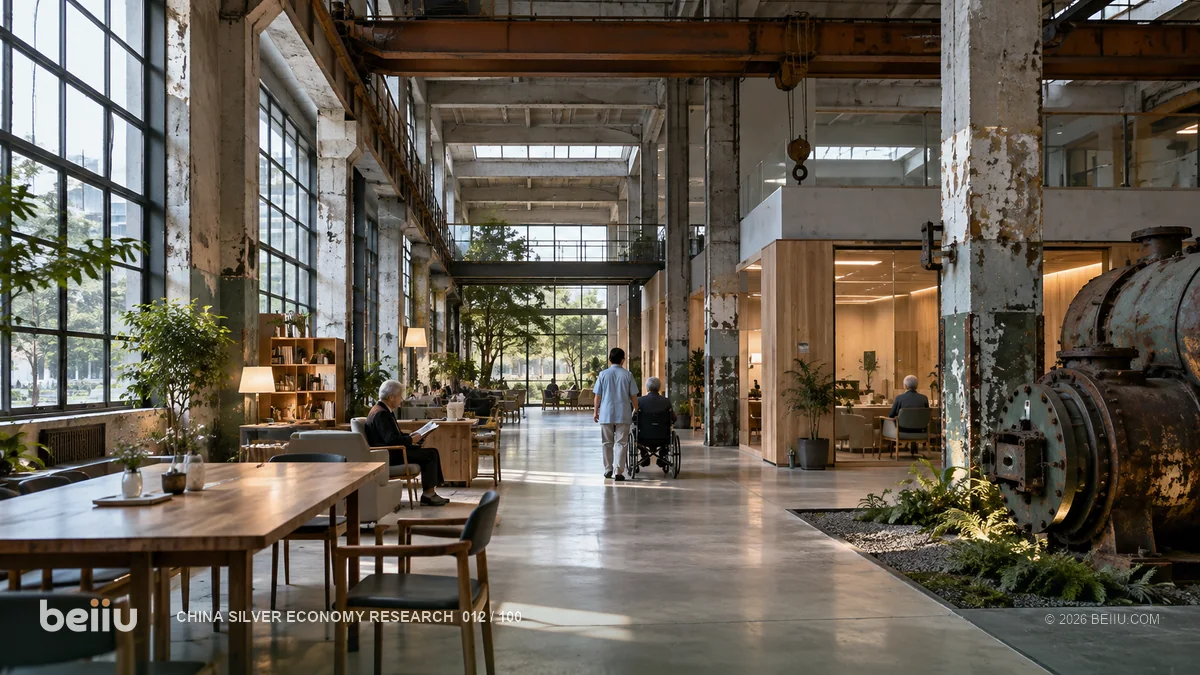
Symbiosis Between Industrial Heritage and Community Elderly Care: Property Rights and Operational Boundaries in Factory Repurposing
Analyze the transformation potential of vacant factories against the backdrop of population aging, with a focus on policy barriers to converting industrial land for elderly care, the lack of medical support, and sustainable operational models
Conclusion: Amid accelerating population aging (with the population aged 60 and above accounting for 23.0%), can vacant factories become new spaces for elderly care, What structural barriers do they face in this transformation
Separate national facts, local variation and analytical inference
Fewer children and more older people do not automatically convert one type of space into another. This study examines “engineering and operation of industrial-space reuse” as a reviewable research object: The unit of analysis is one property and its service catchment, not the national number of closed kindergartens, shops or factories. In claims about “engineering and operation of industrial-space reuse”, increased or declined requires a dated comparison and denominator, while mechanism, opportunity and brand judgment remain analytical rather than statistical.
The research question above requires this minimum evidence base: The minimum baseline covers title, land and planning use, structure and fire safety, accessibility, transport, health links, local need, conversion capex and recurring opex. If “engineering and operation of industrial-space reuse” lacks an element, the study may state a direction or hypothesis, not a local service volume, procurement quantity or revenue estimate.
Read the fact cards, then verify definitions in the primary material
By the end of 2025, the national population aged 60 and above will reach 323.38 million, accounting for 23.0%.
Definition source:National Bureau of Statistics: Statistical Communique of the People's Republic of China on the 2025 National Economic and Social Development
Open primary material ↗National policy explicitly establishes home-based care as the foundation, community-based care as the support, and institutional care as professional backing.
Definition source:CPC Central Committee and State Council: Opinion on Deepening Reform and Development of Elderly-Care Services
Open primary material ↗In 2025, the birth population will be 7.92 million with a birth rate of 5.63‰. Under the trend of population negative growth, labor supply will contract, and demand for traditional industrial land will decline.
Definition source:National Bureau of Statistics: Statistical Communique of the People's Republic of China on the 2025 National Economic and Social Development
Open primary material ↗Primary sources and use boundaries
National Bureau of Statistics: Statistical Communique of the People's Republic of China on the 2025 National Economic and Social Development
The National Bureau of Statistics reports a 2025 year-end population of 1.40489 billion; 323.38 million people aged 60 or over (23.0%) and 223.65 million aged 65 or over (15.9%). There were 7.92 million births and 11.31 million deaths, with natural growth of -2.41 per thousand.
Check source 01 ↗CPC Central Committee and State Council: Opinion on Deepening Reform and Development of Elderly-Care Services
The eldercare reform opinion calls for a tiered, classified, broadly accessible, urban-rural and sustainable service system, with staged objectives for 2029 and 2035.
Check source 02 ↗Ministry of Education: 2025 Statistical Bulletin on National Education Development
The Ministry of Education reports 231,900 kindergartens in 2025, including 203,100 inclusive kindergartens, or 87.57%. The national count does not prove that a particular property is vacant or convertible to eldercare.
Check source 03 ↗Ministry of Education: 2024 Statistical Bulletin on National Education Development
The Ministry of Education reports 253,300 kindergartens in 2024, including 221,000 inclusive kindergartens, or 87.26%.
Check source 04 ↗Ministry of Education: 2023 Statistical Bulletin on National Education Development
The Ministry of Education’s 2023 bulletin records changes in preschool institutions and enrolment. National totals provide context for resource adjustment but do not prove that a particular site is idle or suitable for eldercare conversion.
Check source 05 ↗The fact cards below retain year, geography and source; the source cards return to definitions in the original material. Forecast, research estimate, catalogue listing, policy objective and observed outcome keep different evidence status even when they concern “engineering and operation of industrial-space reuse”.
Move from correlation to a plausible operating mechanism
Transforming vacant factories into elderly care facilities is a complex systematic engineering project, not merely a physical swap of space. The primary obstacle lies in land and planning conditions: whether industrial use can be compatible with elderly care services, whether zoning adjustments are required, and whether related fees must be paid, all subject to the planning rules and regulatory review of the project location. Secondly, industrial buildings often lack accessibility features, natural lighting, ventilation, and fire safety conditions suitable for long-term care, potentially requiring significant renovation investment. More critically, there is the issue of medical integration: projects located far from basic medical and emergency resources will struggle to serve high-care-needs populations. Operationally, it is also necessary to resolve issues regarding payment sources and sustained service capacity. Against the backdrop of declining birth rates and shrinking household sizes, a diversified mechanism linking long-term care insurance, individual payments, commercial insurance, and government support should be explored. Transportation accessibility is equally critical; remote locations will directly limit the service radius.
Industrial reuse also requires investigation of load, seismic condition, contamination and hazardous-use history, daylight, ventilation, fire compartmentation, access and noise; vacancy is not evidence of convertibility. In addition, Planning use, fire safety, transport, health links and operating capacity determine whether existing space can be reused. “Leverage the spacious and high ceilings of factories to build comprehensive elderly care complexes integrating rehabilitation training, day care, and cultural and entertainment activities” still requires temporal order, alternatives, local conditions and accountable implementation rather than a jump from macro correlation to sales or service effect.
Do not turn a national fall in kindergarten numbers into proof that a particular property is convertible. A concrete counterexample is: When remediation, reinforcement, fire work and recurring energy consume operating revenue, heritage value or low rent does not prove a sustainable care use. Until that counterexample to “engineering and operation of industrial-space reuse” is addressed, the conclusion retains conditions and a bounded scope.
Families, public services and industry change differently
For governments, utilizing vacant factories to build regional elderly care centers can optimize urban functional layouts, but caution is needed to avoid 'sunbathing' projects that lack utilization. For families, poor site selection will increase travel burdens for the elderly. For the industry, this requires developers to possess cross-sectoral resource integration capabilities, including medical services, fire safety, planning, and operations. Successful transformation will create new 'Industry + Wellness' business formats, but neglecting compliance and demand matching will lead to significant sunk costs.
For “engineering and operation of industrial-space reuse”, households care about time, cost, dignity and continued choice, public bodies must test identification, equity, fiscal durability and incident accountability, and operators must state the workforce, maintenance and compliance required by “Leverage the spacious and high ceilings of factories to build comprehensive elderly care complexes integrating rehabilitation training, day care, and cultural and entertainment activities” and who pays for exceptions.
Owner, approving authority, designer, contractor and operator need separate signed responsibilities; a future operator cannot absorb every legacy defect. Service radius, cost and access for “engineering and operation of industrial-space reuse” therefore require separate calculations for dense cities, out-migration counties and dispersed rural communities.
Translate the macro judgment into one observable project
Complete due diligence and concept engineering before opening a bounded zone for one function such as day service, rehabilitation, meals or care rather than converting the whole building into mixed use. Start with one place, one population and one task, preserving time, cost, failure and family backfill under the current alternative before introducing “Leverage the spacious and high ceilings of factories to build comprehensive elderly care complexes integrating rehabilitation training, day care, and cultural and entertainment activities”.
The observation period for “engineering and operation of industrial-space reuse” includes routine work, holidays, workforce change, unavailable devices or networks, refusal and exit, and requires the project to show whether the population is identified correctly, incidents close, and people, data and essential service recover when the intervention stops.
An opportunity becomes a project only through constraints
- 01Leverage the spacious and high ceilings of factories to build comprehensive elderly care complexes integrating rehabilitation training, day care, and cultural and entertainment activities
Before turning “Leverage the spacious and high ceilings of factories to build comprehensive elderly care complexes integrating rehabilitation training, day care, and cultural and entertainment activities” into a project, define place, population and the current alternative, then establish a comparable baseline for “permitted use”. For “engineering and operation of industrial-space reuse”, need does not prove that households, institutions or public budgets can pay sustainably.
- 02Combine the historical and cultural value of industrial heritage sites to create distinctive cultural elderly care communities that attract high-paying groups
Validation of “Combine the historical and cultural value of industrial heritage sites to create distinctive cultural elderly care communities that attract high-paying groups” names the user, payer, operator and maintainer separately. If “engineering and operation of industrial-space reuse” relies on permanent extra responsibility from pilot staff, the observed effect is unlikely to survive scale.
- 03Utilize the logistics advantages surrounding vacant factories to establish regional elderly care material distribution centers and medical supply transfer stations
Test this direction against the counterexample “Establish referral collaboration mechanisms with nearby medical institutions and emergency systems based on the care levels of the target service recipients”. “engineering and operation of industrial-space reuse” should move forward only if “target population” still improves after compliance, workforce, maintenance and exit costs are included.
Treat “Leverage the spacious and high ceilings of factories to build comprehensive elderly care complexes integrating rehabilitation training, day care, and cultural and entertainment activities” as a proposition. Move forward only when permitted use improves against baseline and maintenance, workforce, compliance, payment and exit costs are not transferred to older people or frontline staff.
Put conditions that could overturn the conclusion in the main text
- 01Strictly review the feasibility of changing land nature to avoid falling into the predicament of being unable to obtain property certificates
Turn “Strictly review the feasibility of changing land nature to avoid falling into the predicament of being unable to obtain property certificates” into an entry and stop condition for “engineering and operation of industrial-space reuse”, naming who checks it, which record governs and when review occurs. If “Leverage the spacious and high ceilings of factories to build comprehensive elderly care complexes integrating rehabilitation training, day care, and cultural and entertainment activities” remains constrained, future optimisation is not a substitute for pause.
- 02Ensure fire safety acceptance is passed, as evacuation distances and fire-resistant materials in industrial buildings often do not meet elderly care standards
This condition changes the scope of “Combine the historical and cultural value of industrial heritage sites to create distinctive cultural elderly care communities that attract high-paying groups”. Stage review of “engineering and operation of industrial-space reuse” retains non-completion, exit, complaint and excluded-population cases rather than counting only successful entrants.
- 03Establish referral collaboration mechanisms with nearby medical institutions and emergency systems based on the care levels of the target service recipients
For “Establish referral collaboration mechanisms with nearby medical institutions and emergency systems based on the care levels of the target service recipients”, compare rules, resources and cost across city, county and rural settings. National material indicates direction; the local decision on “engineering and operation of industrial-space reuse” still needs field data, accountable owners and an executable alternative.
Put “Strictly review the feasibility of changing land nature to avoid falling into the predicament of being unable to obtain property certificates” into entry and stop criteria. If local data, interviews, complaints or incomplete cases support this counterexample to “engineering and operation of industrial-space reuse”, narrow, modify or stop rather than discard adverse evidence.
Measure average improvement and who is left out
- 01 · permitted use
For “engineering and operation of industrial-space reuse”, “permitted use” retains population, geography, denominator, period and incomplete cases to test “Leverage the spacious and high ceilings of factories to build comprehensive elderly care complexes integrating rehabilitation training, day care, and cultural and entertainment activities”, because an average improvement alone is insufficient.
- 02 · conversion cost
For “engineering and operation of industrial-space reuse”, report baseline, pilot and post-exit states for “conversion cost”, including policy, workforce or system-version changes so external effort is not attributed to the intervention.
- 03 · target population
“engineering and operation of industrial-space reuse” reads “target population” at aggregate and high-risk levels, and coverage does not prove equity when low-income, oldest-old, disabled or remote groups are omitted.
- 04 · operating capacity
“engineering and operation of industrial-space reuse” assigns interpretive responsibility for “operating capacity”: who produces and reviews data, what triggers action and which record governs disagreement.
- 05 · reversibility
For “engineering and operation of industrial-space reuse”, “reversibility” retains population, geography, denominator, period and incomplete cases to test “Combine the historical and cultural value of industrial heritage sites to create distinctive cultural elderly care communities that attract high-paying groups”, because an average improvement alone is insufficient.
permitted use, conversion cost, target population, operating capacity and reversibility answer different questions about scale, process, outcome, equity or cost. Each metric for “engineering and operation of industrial-space reuse” needs a population, denominator, period, version and missing-case record.
Build a durable point of view from evidence
BEIIU maintains that transforming factories for elderly care cannot focus solely on space size but must prioritize 'compliance costs' and 'medical radius.' Given the overarching trend of declining birth rates, such projects should be positioned as regional specialized institutions rather than community-wide welfare facilities, achieving break-even through refined operations.
BEIIU / 辈佑 considers public evidence, scenario constraints and real-world counterexamples together to identify which opportunities can move into product and partnership practice and which conditions require further observation. New primary evidence and field experience will continue to refine that perspective.
Turn macro research into five practical questions
Fact boundary
For “engineering and operation of industrial-space reuse”, what can national evidence establish, what can it not establish, and which local data are required to answer the opening research question?
Current alternative
Before a new product or service addresses “engineering and operation of industrial-space reuse”, how do families, communities or institutions complete the task, and what are its time, cost, failure and user-burden baselines?
Minimum test
Choose one bounded setting from “Leverage the spacious and high ceilings of factories to build comprehensive elderly care complexes integrating rehabilitation training, day care, and cultural and entertainment activities”, change one material condition, and test “permitted use” together with at least one counter-metric.
Counterexample
For “engineering and operation of industrial-space reuse”, actively look for “Strictly review the feasibility of changing land nature to avoid falling into the predicament of being unable to obtain property certificates”; if it limits “Leverage the spacious and high ceilings of factories to build comprehensive elderly care complexes integrating rehabilitation training, day care, and cultural and entertainment activities” locally, narrow the conclusion and decide whether to pause or use another path.
Public accountability
For “engineering and operation of industrial-space reuse”, name who authorises entry, operates, handles exceptions, maintains data and equipment, and may stop the service; a missing role leaves the proposal as a hypothesis.
The continue, change or stop floor is: Stop conversion when use cannot be approved, structural or fire cost is unaffordable, catchment demand is insufficient, or the exit use cannot be restored. For “engineering and operation of industrial-space reuse”, repeat this check at entry, mid-pilot and scale review, updating the conclusion, budget, ownership and exit arrangement.
References
For “engineering and operation of industrial-space reuse”, this study prioritises original government, public-institution and international sources, retains reference years, and clearly labels forecasts or estimates.
- National Bureau of Statistics: Statistical Communique of the People's Republic of China on the 2025 National Economic and Social Development ↗
- CPC Central Committee and State Council: Opinion on Deepening Reform and Development of Elderly-Care Services ↗
- Ministry of Education: 2025 Statistical Bulletin on National Education Development ↗
- Ministry of Education: 2024 Statistical Bulletin on National Education Development ↗
- Ministry of Education: 2023 Statistical Bulletin on National Education Development ↗