
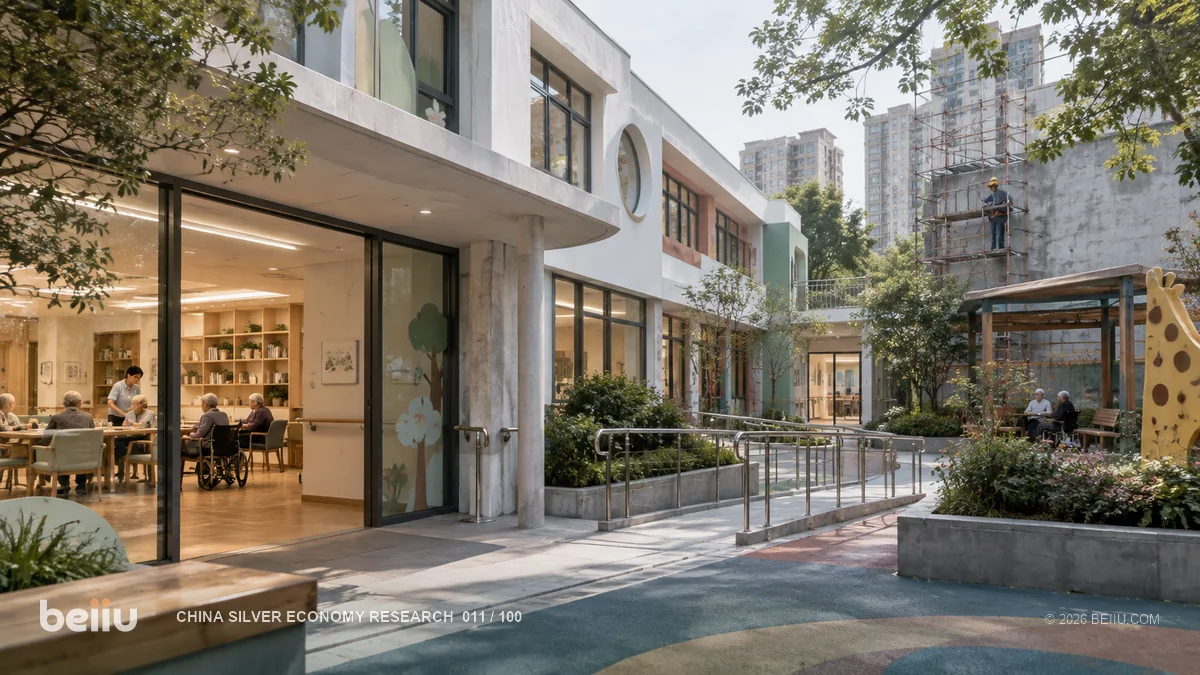
Reconfiguring Stock Spaces in Shrinking Communities: A Compliant Path from Kindergarten Closures to Community Elderly Care Hubs
Based on data showing a sharp decline in the number of kindergartens in 2023-2024, exploring the feasibility of transforming idle school buildings under property rights, fire safety, and barrier-free modifications, emphasizing the necessity of medical collaboration and operational validation
Conclusion: Against the backdrop of a sustained decline in birth rates leading to the closure of numerous kindergartens, can idle school buildings be directly converted into community elderly care facilities, What are the core constraints
Separate national facts, local variation and analytical inference
Fewer children and more older people do not automatically convert one type of space into another. This study examines “compliance and operation of kindergarten conversion” as a reviewable research object: The unit of analysis is one property and its service catchment, not the national number of closed kindergartens, shops or factories. In claims about “compliance and operation of kindergarten conversion”, increased or declined requires a dated comparison and denominator, while mechanism, opportunity and brand judgment remain analytical rather than statistical.
The research question above requires this minimum evidence base: The minimum baseline covers title, land and planning use, structure and fire safety, accessibility, transport, health links, local need, conversion capex and recurring opex. If “compliance and operation of kindergarten conversion” lacks an element, the study may state a direction or hypothesis, not a local service volume, procurement quantity or revenue estimate.
Read the fact cards, then verify definitions in the primary material
In 2023, the number of kindergartens nationwide decreased by 14,808 compared to the previous year, with a reduction of 5.3457 million children in attendance.
Definition source:Ministry of Education: 2023 Statistical Bulletin on National Education Development
Open primary material ↗The total number of kindergartens in 2024 further dropped to 253,300, but data indicates that the national decline in total quantity does not equate to every closed kindergarten being convertible into an elderly care facility.
Definition source:Ministry of Education: 2024 Statistical Bulletin on National Education Development
Open primary material ↗Policy requirements aim to establish a basic elderly care service network by 2029, affirming the status of institutional elderly care as professional support.
Definition source:CPC Central Committee and State Council: Opinion on Deepening Reform and Development of Elderly-Care Services
Open primary material ↗Primary sources and use boundaries
Ministry of Education: 2023 Statistical Bulletin on National Education Development
The Ministry of Education’s 2023 bulletin records changes in preschool institutions and enrolment. National totals provide context for resource adjustment but do not prove that a particular site is idle or suitable for eldercare conversion.
Check source 01 ↗Ministry of Education: 2024 Statistical Bulletin on National Education Development
The Ministry of Education reports 253,300 kindergartens in 2024, including 221,000 inclusive kindergartens, or 87.26%.
Check source 02 ↗CPC Central Committee and State Council: Opinion on Deepening Reform and Development of Elderly-Care Services
The eldercare reform opinion calls for a tiered, classified, broadly accessible, urban-rural and sustainable service system, with staged objectives for 2029 and 2035.
Check source 03 ↗Ministry of Education: 2025 Statistical Bulletin on National Education Development
The Ministry of Education reports 231,900 kindergartens in 2025, including 203,100 inclusive kindergartens, or 87.57%. The national count does not prove that a particular property is vacant or convertible to eldercare.
Check source 04 ↗The fact cards below retain year, geography and source; the source cards return to definitions in the original material. Forecast, research estimate, catalogue listing, policy objective and observed outcome keep different evidence status even when they concern “compliance and operation of kindergarten conversion”.
Move from correlation to a plausible operating mechanism
The structural contraction in the number of kindergartens (a reduction of nearly 15,000 in 2023) provides a physical basis for the reallocation of stock spaces, but this is not an automatic conversion process. Converting idle school buildings into elderly care facilities faces multiple hard constraints: first is the change in planning purpose, which requires approval from the natural resources department to ensure land nature complies with elderly care land requirements; second is fire safety acceptance, as old school buildings often do not meet current 'Building Design Fire Code' standards regarding evacuation channels and fire compartments, resulting in high renovation costs; third is medical collaboration, as mere daily living care cannot replace professional medical nursing, necessitating the introduction of community health service centers or the establishment of green channels. Furthermore, barrier-free modifications (such as installing elevators and anti-slip flooring) and the configuration of age-friendly facilities are hard thresholds. At the operational level, strict feasibility studies are required to confirm whether there is sufficient demand for disabled or semi-disabled elderly within a 1-kilometre radius, avoiding blind transformation that leads to resource idleness.
A fall in kindergarten numbers establishes an aggregate education trend; it does not prove that one building is vacant or replace title, use, fire, structural and operating review. In addition, Planning use, fire safety, transport, health links and operating capacity determine whether existing space can be reused. “Leverage the familiar community environment of the original kindergarten to quickly establish trust relationships, reducing resistance to promoting community elderly care services” still requires temporal order, alternatives, local conditions and accountable implementation rather than a jump from macro correlation to sales or service effect.
Do not turn a national fall in kindergarten numbers into proof that a particular property is convertible. A concrete counterexample is: When the property still carries education duties, title is disputed or required care conditions cannot be obtained, the sound conclusion may be not to convert. Until that counterexample to “compliance and operation of kindergarten conversion” is addressed, the conclusion retains conditions and a bounded scope.
Families, public services and industry change differently
For families, successful transformation means the emergence of an elderly care service center within walking distance in the community, reducing the care radius; for the government, this helps revitalize stock assets, alleviate fiscal pressure, and optimize community service layouts; for the industry, this marks a paradigm shift from new construction to stock renovation, requiring operators to possess the integration capability of multiple licenses (education to elderly care, medical, fire safety). If compliance is ignored, blind transformation not only fails to obtain operational permits but may also trigger legal risks due to safety hazards.
For “compliance and operation of kindergarten conversion”, households care about time, cost, dignity and continued choice, public bodies must test identification, equity, fiscal durability and incident accountability, and operators must state the workforce, maintenance and compliance required by “Leverage the familiar community environment of the original kindergarten to quickly establish trust relationships, reducing resistance to promoting community elderly care services” and who pays for exceptions.
Owner, approving authority, designer, contractor and operator need separate signed responsibilities; a future operator cannot absorb every legacy defect. Service radius, cost and access for “compliance and operation of kindergarten conversion” therefore require separate calculations for dense cities, out-migration counties and dispersed rural communities.
Translate the macro judgment into one observable project
Review each property for title, planning use, egress, vertical circulation, sanitation and kitchen conditions, nearby older residents and catchment, with separate conversion and operating cash flows. Start with one place, one population and one task, preserving time, cost, failure and family backfill under the current alternative before introducing “Leverage the familiar community environment of the original kindergarten to quickly establish trust relationships, reducing resistance to promoting community elderly care services”.
The observation period for “compliance and operation of kindergarten conversion” includes routine work, holidays, workforce change, unavailable devices or networks, refusal and exit, and requires the project to show whether the population is identified correctly, incidents close, and people, data and essential service recover when the intervention stops.
An opportunity becomes a project only through constraints
- 01Leverage the familiar community environment of the original kindergarten to quickly establish trust relationships, reducing resistance to promoting community elderly care services
For “compliance and operation of kindergarten conversion”, “Leverage the familiar community environment of the original kindergarten to quickly establish trust relationships, reducing resistance to promoting community elderly care services” starts with one place, one task and one defined population, records routine, exception, refusal and incomplete cases, and retains a workable path without the intervention.
- 02Combine the original campus outdoor activity grounds to transform them into elderly rehabilitation training and social centers, enhancing service added value
Before turning “Combine the original campus outdoor activity grounds to transform them into elderly rehabilitation training and social centers, enhancing service added value” into a project, define place, population and the current alternative, then establish a comparable baseline for “conversion cost”. For “compliance and operation of kindergarten conversion”, need does not prove that households, institutions or public budgets can pay sustainably.
- 03Introduce smart elderly care equipment to reduce reliance on a large number of caregivers, achieving sustainable asset-light operations
Validation of “Introduce smart elderly care equipment to reduce reliance on a large number of caregivers, achieving sustainable asset-light operations” names the user, payer, operator and maintainer separately. If “compliance and operation of kindergarten conversion” relies on permanent extra responsibility from pilot staff, the observed effect is unlikely to survive scale.
Treat “Leverage the familiar community environment of the original kindergarten to quickly establish trust relationships, reducing resistance to promoting community elderly care services” as a proposition. Move forward only when permitted use improves against baseline and maintenance, workforce, compliance, payment and exit costs are not transferred to older people or frontline staff.
Put conditions that could overturn the conclusion in the main text
- 01Strictly prohibit unauthorized changes to building usage before passing fire safety acceptance and planning purpose change approvals
Once “Strictly prohibit unauthorized changes to building usage before passing fire safety acceptance and planning purpose change approvals” holds, pause the affected stage and establish facts before narrowing, modifying or exiting. Risk in “compliance and operation of kindergarten conversion” cannot be assigned to user capability or absorbed indefinitely by families and frontline staff.
- 02Must verify the surrounding population structure to avoid forcibly constructing nursing beds for disabled elderly in communities with a young demographic profile
Turn “Must verify the surrounding population structure to avoid forcibly constructing nursing beds for disabled elderly in communities with a young demographic profile” into an entry and stop condition for “compliance and operation of kindergarten conversion”, naming who checks it, which record governs and when review occurs. If “Combine the original campus outdoor activity grounds to transform them into elderly rehabilitation training and social centers, enhancing service added value” remains constrained, future optimisation is not a substitute for pause.
- 03Must reserve sufficient medical collaboration interfaces to ensure emergency response times meet regulatory requirements
This condition changes the scope of “Introduce smart elderly care equipment to reduce reliance on a large number of caregivers, achieving sustainable asset-light operations”. Stage review of “compliance and operation of kindergarten conversion” retains non-completion, exit, complaint and excluded-population cases rather than counting only successful entrants.
Put “Strictly prohibit unauthorized changes to building usage before passing fire safety acceptance and planning purpose change approvals” into entry and stop criteria. If local data, interviews, complaints or incomplete cases support this counterexample to “compliance and operation of kindergarten conversion”, narrow, modify or stop rather than discard adverse evidence.
Measure average improvement and who is left out
- 01 · permitted use
“compliance and operation of kindergarten conversion” assigns interpretive responsibility for “permitted use”: who produces and reviews data, what triggers action and which record governs disagreement.
- 02 · conversion cost
For “compliance and operation of kindergarten conversion”, “conversion cost” retains population, geography, denominator, period and incomplete cases to test “Combine the original campus outdoor activity grounds to transform them into elderly rehabilitation training and social centers, enhancing service added value”, because an average improvement alone is insufficient.
- 03 · target population
For “compliance and operation of kindergarten conversion”, report baseline, pilot and post-exit states for “target population”, including policy, workforce or system-version changes so external effort is not attributed to the intervention.
- 04 · operating capacity
“compliance and operation of kindergarten conversion” reads “operating capacity” at aggregate and high-risk levels, and coverage does not prove equity when low-income, oldest-old, disabled or remote groups are omitted.
- 05 · reversibility
“compliance and operation of kindergarten conversion” assigns interpretive responsibility for “reversibility”: who produces and reviews data, what triggers action and which record governs disagreement.
permitted use, conversion cost, target population, operating capacity and reversibility answer different questions about scale, process, outcome, equity or cost. Each metric for “compliance and operation of kindergarten conversion” needs a population, denominator, period, version and missing-case record.
Build a durable point of view from evidence
The core of stock renovation lies not in 'changing' but in 'matching'. BEIIU believes that kindergarten-to-elderly-care conversion possesses both commercial and social value only when property rights are clear, fire safety standards are met, medical collaboration is in place, and demand is validated by data; otherwise, other commercial formats should be explored first.
BEIIU / 辈佑 considers public evidence, scenario constraints and real-world counterexamples together to identify which opportunities can move into product and partnership practice and which conditions require further observation. New primary evidence and field experience will continue to refine that perspective.
Turn macro research into five practical questions
Fact boundary
For “compliance and operation of kindergarten conversion”, what can national evidence establish, what can it not establish, and which local data are required to answer the opening research question?
Current alternative
Before a new product or service addresses “compliance and operation of kindergarten conversion”, how do families, communities or institutions complete the task, and what are its time, cost, failure and user-burden baselines?
Minimum test
Choose one bounded setting from “Leverage the familiar community environment of the original kindergarten to quickly establish trust relationships, reducing resistance to promoting community elderly care services”, change one material condition, and test “permitted use” together with at least one counter-metric.
Counterexample
For “compliance and operation of kindergarten conversion”, actively look for “Strictly prohibit unauthorized changes to building usage before passing fire safety acceptance and planning purpose change approvals”; if it limits “Leverage the familiar community environment of the original kindergarten to quickly establish trust relationships, reducing resistance to promoting community elderly care services” locally, narrow the conclusion and decide whether to pause or use another path.
Public accountability
For “compliance and operation of kindergarten conversion”, name who authorises entry, operates, handles exceptions, maintains data and equipment, and may stop the service; a missing role leaves the proposal as a hypothesis.
The continue, change or stop floor is: Stop conversion when use cannot be approved, structural or fire cost is unaffordable, catchment demand is insufficient, or the exit use cannot be restored. For “compliance and operation of kindergarten conversion”, repeat this check at entry, mid-pilot and scale review, updating the conclusion, budget, ownership and exit arrangement.
References
For “compliance and operation of kindergarten conversion”, this study prioritises original government, public-institution and international sources, retains reference years, and clearly labels forecasts or estimates.
- Ministry of Education: 2023 Statistical Bulletin on National Education Development ↗
- Ministry of Education: 2024 Statistical Bulletin on National Education Development ↗
- CPC Central Committee and State Council: Opinion on Deepening Reform and Development of Elderly-Care Services ↗
- Ministry of Education: 2025 Statistical Bulletin on National Education Development ↗